(cont'd...pages 246-583)
There may be spoilers in this section, so if you have ANY inclination whatsoever to read this book, I'd steer clear of this particular part of the review. Otherwise, feel free to press on.
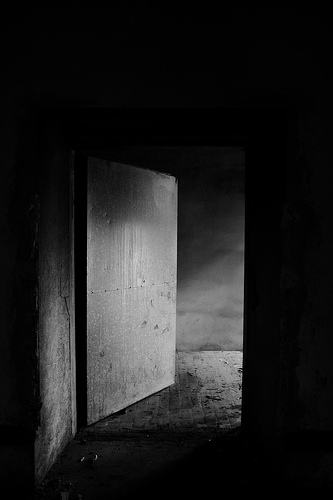
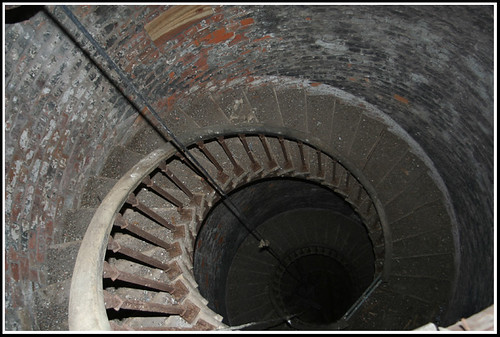
The original trio of explorers haven't been heard from in several days. Will Navidson, his brother Tom, and friend Reston decide to make the trip into the void that lies beyond this door. A dark spiral staircase has been found and seems to be one of the only parts of the void that remains. It stretches up and down and outward, lengthening and shortening one's journey along it, but does not disappear. It is a landmark of sorts in this place of infinite blackness.
Halloway, one of the original trio, has since lost it. He has shot at his companions, who now cower in one of the hundreds of side rooms that seem to appear on a whim. Navidson and Reston finally find them and get them out of the "great hallway" as they've come to call it while the house seems to devour Halloway, leaving no trace of the man. He is gone.
Karen, Navidson's wife, is now preparing to leave the house. She doesn't want to stay there any longer and for good reason. The marriage is fracturing and splintering even more now. The kids have developed strange and unexplainable quirks. As Navidson, his brother and Reston emerge with the the other two explorers (one of whom has died from Halloway's shooting him), the house lashes out. Where before the house had left its actions firmly rooted behind the appearing door and in the hallway beyond, now it has moved out into every other part of the house. The black closes in on the family quickly, turning the house upside down and inside out and taking Navidson's brother with it. Navidson watches his brother, a man he's finally gotten on better terms with after so many years, get swallowed by the house.
Throughout all this are the sexual exploits of Johnny Truant and his friend Lude in the footnotes. But it's not the sexual and drug-fueled escapades that become important so much as it is the truth that becomes imperative to Johnny. He's copying every word of Zampano's original notes down and yet finds his life spiraling every downward. He never leaves his home, he loses his job, he stops eating...he looks like death to most people, but eventually goes on a kind of journey to find the house or any of the people involved in creating this whole storyline.
I hesitate to call this book a love story, though that is indeed what Navidson and Karen's story becomes; it is a reaffirmation of their love for each other once their facades have been completely ripped away over the course of the following months during their separation. Johnny Truant's story, however, feels more like that of a monk, designated to copy the story of the house down in an effort to make sure that it remains vibrant and alive despite all evidence to the contrary.
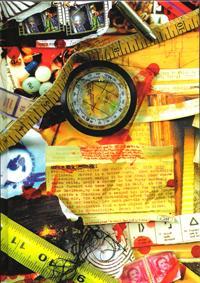
Like I said before in my last entry, this book is a puzzle. After all is said and done, there are some photos of collages that have been put together, a part of which is a card of symbols for (I'm assuming) airline pilots or hikers. One of the symbols is a kind of Roman Numberal II, printed on both the inside front and back covers. This symbol means "require medical supplies." Take from that what you will.
The cover is a beautifully embossed maze convalescing into a golden spiral shape with a compass at its center. The cover is just shy of covering the whole book, which some have speculated is a metaphor for the hallway's dimensions in relation to the rest of the house; they do not coexist in the same temporal space. Their measurements will never become equal.
The deeper I get into the storylines, the more I want of the academic deconstruction of "The Navidson Record." By breaking it down from an almost nearly objective viewpoint, Danielewski allows the important moments to become supercharged with emotion without relying on terrible metaphors or bad descriptions. Keeping it academic approaches the terrorizing nature of the house against the family in a way that actually felt more terrifying as a reader.
And as much as I lost my empathy for Truant the longer the book went on, the writing in his sections was phenomenal. It was like watching a slow burn, a junkie dying a physical death, a man completely losing himself over the course of a year or two. The pacing was just right, as was the introspective nature of many of the passages. You could see that the story of the house, real or fictional, was taking its toll on Johnny. This has led some to wonder whether "The Navidson Record" is even real to Johnny. Or whether Zampano even really exists.
Fun fact: Danielewski's sister is none other than modern rock singer Poe, who created the album "Haunted" based on her brother's book.
Having finished this book within a week, but having not explored all the inner secrets of it quite yet, I realize that my own novel is pathetically anemic. This was Danielewski's first book and granted it may have taken him ten years to complete it, I understand how far I have to go at this point in order to achieve something of this magnitude. The pure creativity that has to exist for this kind of text to happen is through the roof and only makes me want to press harder into my own dark labyrinth of text.
(3,434)
Monday, October 24, 2011
Saturday, October 22, 2011
(Review) Mark Z. Danielewski's "House of Leaves" (Pt. 1 of 2)
This is part one of a two part review. It spans pages 1-245 and pages 584-644 (this will make sense later).
I'm breaking this review up into two parts for a couple reasons:
1.) This is one of the thickest books I've ever read.
2.) This is one of the most dense, most frightening, most complex books I've ever read.
I'm something of a nerd when it comes to the paranormal. I think there's something fascinating with confronting those things we don't understand, that we can't understand. We, the living, are death-focused. We ponder the existence of life after death and the possibility of death trying to remain in the world of the living. It's provocative and it's interesting; the unexplainable will forever be at the forefront of our collective imaginations.
I saw a show awhile back about the haunting of an old southern prison that people used to call "The Sugarhouse." It was called such because it's where the slaves and prisoners were taken "to be sweetened up" in order to give information to their jailors. Many of these prisoners died from various forms of torture and thus, their spirits are said to still haunt the grounds.
This got me thinking about writing my own horror story, something I had never thought about before as the stories I'd always wanted to tell were on the far other side of the spectrum of reality. But then another show called "American Horror Story" (my review here) showed up on the FX channel and really convinced me that I should give it a try. From my bookshelf, I started looking at various books that explored the world of horror and decided upon Danieleski's "House of Leaves," which has turned out to be a great jump-off point for my next writing endeavor.
Sitting at a lofty 709 pages, the text and formatting make it closer to a 1400 page book. We start off in the perspective of our first narrator (there are multiple), a tattoo artist named Johnny Truant. His friend Lude shows him the apartment of a man who died. In this apartment they find pages upon pages of the former occupant's writing which is essentially what the actual book is; it is the documentation, in a scholarly style (a thesis or doctoral research paper) of a collection of footage called "The Navidson Record." In this apartment, they also find several locks on the door, fingernail scratchings in the floor, and all the windows shut lock-tight with no way of being opened. The former occupant, a man named Zampano, has compiled these pages and notated them with quotes from books that don't exist or cannot be found.
From this point on, we're essentially reading "The Navidson Record" at the same time as Truant. "The Navidson Record" turns out to be the video footage, spliced and edited post-trauma, of a family moving into a house. One day, a door appears in their hallway that wasn't there before and, upon an initial inspection by the father (simply called Navy in most instances), the hallway extends for miles...out through where their backyard should be. It is an impossible situation that logic cannot deconstruct. The halls should not exist since the backyard is still there, but they do. The door should not exist, but it does.
(3,298)
I'm breaking this review up into two parts for a couple reasons:
1.) This is one of the thickest books I've ever read.
2.) This is one of the most dense, most frightening, most complex books I've ever read.
I'm something of a nerd when it comes to the paranormal. I think there's something fascinating with confronting those things we don't understand, that we can't understand. We, the living, are death-focused. We ponder the existence of life after death and the possibility of death trying to remain in the world of the living. It's provocative and it's interesting; the unexplainable will forever be at the forefront of our collective imaginations.
I saw a show awhile back about the haunting of an old southern prison that people used to call "The Sugarhouse." It was called such because it's where the slaves and prisoners were taken "to be sweetened up" in order to give information to their jailors. Many of these prisoners died from various forms of torture and thus, their spirits are said to still haunt the grounds.
This got me thinking about writing my own horror story, something I had never thought about before as the stories I'd always wanted to tell were on the far other side of the spectrum of reality. But then another show called "American Horror Story" (my review here) showed up on the FX channel and really convinced me that I should give it a try. From my bookshelf, I started looking at various books that explored the world of horror and decided upon Danieleski's "House of Leaves," which has turned out to be a great jump-off point for my next writing endeavor.
Sitting at a lofty 709 pages, the text and formatting make it closer to a 1400 page book. We start off in the perspective of our first narrator (there are multiple), a tattoo artist named Johnny Truant. His friend Lude shows him the apartment of a man who died. In this apartment they find pages upon pages of the former occupant's writing which is essentially what the actual book is; it is the documentation, in a scholarly style (a thesis or doctoral research paper) of a collection of footage called "The Navidson Record." In this apartment, they also find several locks on the door, fingernail scratchings in the floor, and all the windows shut lock-tight with no way of being opened. The former occupant, a man named Zampano, has compiled these pages and notated them with quotes from books that don't exist or cannot be found.
From this point on, we're essentially reading "The Navidson Record" at the same time as Truant. "The Navidson Record" turns out to be the video footage, spliced and edited post-trauma, of a family moving into a house. One day, a door appears in their hallway that wasn't there before and, upon an initial inspection by the father (simply called Navy in most instances), the hallway extends for miles...out through where their backyard should be. It is an impossible situation that logic cannot deconstruct. The halls should not exist since the backyard is still there, but they do. The door should not exist, but it does.
While we get the very academic deconstruction of the video footage (through quotes from books about the incident and scientific explanations of echoes and mythology in regards to labyrinths), we also get to see the slow fracturing of not only the Navidson family, but of our main narrator, Truant, as well. Truant's prose becomes more grandiose and lofty as each page passes. The more he reads of the document, the more he feels like he's "losing it," at one point even imagining that he leaves his apartment only to be hit by a truck, flung on to the top of his car, which is then run into by the same truck, which then spills gas and the possibility of an explosion. In fact, this moment is pure hallucination on his part. These moments come more and more often the deeper we delve into the text.
When Navidson realizes that he has a serious issue with his house, he calls not only his brother (with whom he had a rocky relationship), but also later calls in a team of outdoorsmen who are well-versed in traversing new and unexplored areas - people who have experience in intentionally getting lost. This is where the book starts getting wonky.
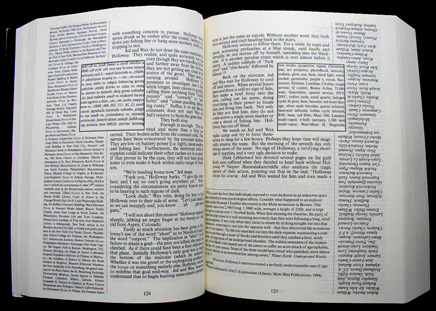
At first, I didn't much care for the strange formatting; footnotes ended up sideways on the upper parts of pages, bits of text were turned backwards in their own little boxes in the middle of the page (see above photo) and often contained a litany of names and places that seemed to have no real bearing on either of the two storylines running at that point. But I realized soon that, while the explorers were getting lost in this new cavernous and unexplainable hallway (for 8 DAYS!!!), the text itself was mimicking the kind of shape-changing effect that the hallway had for those involved. Nothing was static, everything was up for grabs. Stability of anything could not be counted on. Everything about these passages was psychological terror and it worked.
There are a few appendices in the back that are referred to in this first section, one of which are the letters Truant's mother sends him from a mental home while he's bouncing around from foster home to foster home. I absolutely cannot ruin my favorite letter, one that I spent an hour decoding by making words and sentences from the first letter of each word in the nonsensical text, but suffice it to say that it wasn't the first time Danielewski uses the text in an incredibly effective way to bring about more terror on the part of the reader in an effort to empathize with the characters. The process of the decoding was slow, agonizing, drawn out, and absolutely powerful. I felt my chest constrict as I realized what the hidden message said.
I have stopped at page 245 to write this because the more I read, the more engrossed I become. The explorers are lost in the cavernous hallway, which has itself produced a downward-spiraling staircase into an unimaginable black depth and more hallways and rooms for them to explore. Navidson and his brother and their friend have gone in after the explorers, knowing that something terrible has happened to one or all of them. I know that if I don't stop now, I will have finished this book by nightfall and I almost want to relish the delicious terror that is building up at a grueling pace.
Despite some very tangential movements in the storyline, both in the academic deconstruction and Truant's interludes and commentary, I'm thoroughly engrossed in this book. It's taken some serious patience to get through some of the initial chapters, but it's absolutely paying off right now. I have zero idea as to how this will end and there are very few clues leading me on. The book is a puzzle to be solved. So much so, in fact, that there is a web forum devoted to picking apart each little clue that Danielewski leaves scattered throughout the book. Like a vision of something truly terrible and unimaginable, I can't take my eyes off it for fear of losing it altogether...
(3,298)
Friday, October 21, 2011
The Cremaster Cycle
The Cremaster Cycle...where to even begin with this. These art installations/videos/mind-scramblers are the brainchildren of Matthew Barney, husband to Icelandic Queen of Pop, Bjork. I have yet to watch all of them all the way through (I believe there are some 7+ hours worth of footage/storyline spanning the different cycles). Below are some teaser/trailers for each one and a description. If you've got nothing else going on and want to take a drug-free trip, have at it. There's not a whole lot else to compare these to. Think Shakespeare meets mythology meets Hunter S. Thompson meets Pan's Labyrinth meets LSD and you've about got the jist of things.
Nancy Spector has described the Cremaster cycle (1994–2002) as "a self-enclosed aesthetic system."[2] The cycle includes the films as well as photographs, drawings, sculptures, and installations the artist produced in conjunction with each episode. Its conceptual departure point is the male cremaster muscle, the primary function of which is to raise and lower the testes in response to temperature.
The project is filled with anatomical allusions to the position of the reproductive organs during the embryonic process of sexual differentiation: Cremaster 1 represents the most "ascended" or undifferentiated state, Cremaster 5 the most "descended" or differentiated.
The cycle repeatedly returns to those moments during early sexual development in which the outcome of the process is still unknown — in Barney's metaphoric universe, these moments represent a condition of pure potentiality. As the cycle evolved over eight years, Barney looked beyond biology as a way to explore the creation of form, employing narrative models from other realms, such as biography, mythology, and geology.
The films were not made in numerical order (1–5), but rather in the order 4, 1, 5, 2, 3 – precisely, 4 in 1994, 1 in 1995, 5 in 1997, 2 in 1999, 3 in 2002. The numerical order is the thematic order, while in order of production the films increase in production quality and ambition, and they can alternatively be viewed in any order, as different views of a set of themes and preoccupations.
The films are significantly different in length; the longest (and last-made) is #3, at over 3 hours, while the remaining four are approximately 1 hour each, for a total of approximately 7 hours – #3 itself is almost half the total length. There is precious little dialog in any of the films; only #2 features significant dialog.[3]
An important precursor of the Cremaster Cycle is Drawing Restraint, which is also a biologically inspired multi-episode work in multiple media, also featuring the field emblem.
Part One of Cycle One
Part One of Cycle Two
Part One of Cycle Three
Part One of Cycle Four
Part One of Cycle Five
(3,253)
Tuesday, October 18, 2011
Flash Fiction - "Weather Vain"
I hate dinner parties, the ones where I’m the odd man out and everyone else seems to know each other. I know nothing about these people and they know nothing about me, so the obligatory “getting to know you” conversations occur every half an hour. Someone new shows up and I’m introduced again and again, putting my most current biography on repeat and everyone falls asleep at the same part.
‘There are 50 of us,’ I say, trying to make it sound glamorous and special at the start. ‘One for every state. We have our own offices away from the rest of the building. They are air-conditioned and made to look like a small home away from home and that is where I work for 24 hours a day.’
At this point I’m usually asked if I have my own home. ‘No. Once you have this job, you never really get another one,’ and they will ooh and ahh as if I’m the most exciting thing to have stepped in the party. ‘Once hired, we move into these separate office-homes, pre-fab and already furnished with utilities paid.’
Their eyes will widen and their mouths will form o’s in wonder as they hang on to my every word. ‘What IS it you do?’ they ask, now more curious than ever and I will explain that my work touches everyone on a global scale and this excites them even further until I’m almost afraid that they shall eat me instead of the appetizers beautifully laid out on the kitchen counter.
‘I manage anywhere from 20-40 video cameras in my living room at any given moment, keeping a constant vigil on the weather. When you see the weather channel, I’m the lone person doing that. I AM the weather channel,’ I say as confidently as possible and then sipping my drink so I don’t see the disappointment in their eyes.
I see it in their lips, the hesitation and the halting of an upturned nose at this news. Suddenly, their canapés don’t taste as good and they need a refill of whatever drink had been their friend that night and I am left to wait around until the next curious person makes to shake my hand.Sometimes I get lucky and a new person will come around who has yet to be briefed by the rest of the party and I pretend to be something else. I will shroud myself in faux secrecy and hopefully keep someone’s attention long enough to get past my occupation and into conversation I am lacking at home. I’d stop coming to these dinner parties, but I have no one to talk to at home but my equipment.
(3,150)
Friday, October 14, 2011
Books On Deck / Up Next (Pt. II)
One of the newer sections of "Impasto" is being told in stage-play/screenplay format, so I'm getting back to reading some old plays by more contemporary writers. I'm also trying to read more of the super experimental stuff to get my mind moving again as I feel a little stagnant creatively. I'm hoping to jar a few ideas loose over the next month and a half, so here are a few things on my to-read list:
(2,971)
(2,971)
Thursday, October 13, 2011
Bravo's "Work of Art"
I have a strange kind of love affair with the Bravo network. On one hand, they produce shows like The Real Housewives of Who Really Cares County and The Millionaire Matchmaker, shows that are so vapid and stupid one must read a book immediately just to replenish brain cells. On the other hand, they produce shows like Top Chef and Work of Art that highlight the fascinating creative process of individuals. I find the latter the most interesting. If more reality television looked like TC and WoA, we'd all be better for it.
I remember watching the first season of WoA and hoping like hell it would get a second season. I don't really care about the personalities of the contestants (though there's something to be said for ego being the cause of one's downfall in almost every situation), but I like that these shows really get behind the thinking and the artistry behind the finished product. We need more thinking, more doing, more brains working in tandem to create and fill the world with new and surprising things.
The first season was a good cross-section of styles: photographers, mixed media, performance artists. Abdi Farah, a super likeable seeming guy, won the season overall. Against even someone from my hometown of Kansas City, I felt he earned the win. Much of what he created was aesthetically engaging but had emotional content as well.
Season Two has started and they've done a good job of casting another cast of talented artists that utilize every medium available. If you'd like to stretch your brain a bit from all the other McTelevision shows out there, give this one a whirl. Getting a behind-the-scenes look at the creative process can often unlock your own creativity in some way, shape, or form. And really...wouldn't you rather watch someone create a piece of art as opposed to watching trashy old women act like drunken sorostitutes anyway?
(2,881)
Sunday, October 9, 2011
Craft - Pt. 8 / Distractions, Distractions, Distractions
There was a reason I flunked out of college my first time around; my focus was nowhere to be found. I was listless, but away from home for the first time. I was on my own and completely wasted what could have been a solid education. Looking back on things, I know now that every decision I've made has led me to the immediate moment, a moment where I genuinely feel that I'm supposed to be. Every piss poor decision has come to this existence in San Francisco. I think I can safely call myself a Fatalist now; I'm a firm believer that certain things happen in life in order to put us where we need to be.
As in life, distractions are a part of writing. These distractions can be both good and bad, but it's a matter of you, the individual, taking over the reins sometimes. Don't feel like writing on a particular day? Don't - but involve yourself in something that can possibly influence the writing. With "Impasto" being a book about art and relationships, my free time should be spent with the people I consider friends or spent walking through a museum and soaking up every minute in the service of the novel. But that's not what's happening.
I've got documentaries on artists on my computer that need to be watched, if only to get into the mindset of a physical artist even if they aren't the ones showing up in my novel. Documentaries about artistic movements, artists, thefts, anything...one small bit of information can flick on the light switch of inspiration and last for several pages. So far, I've just been distracted without anything playing a role in the writing of my book.
This is normal. This is okay. You're going to get distracted, you're going to find yourself going off the rails for weeks where the writing just isn't coming. I find that after these periods of non-writing (we're talking less than 10 pages a month, which is unacceptable for me, personally), there is a floodgate that unleashes everything sitting on the surface of your subconscious, waiting to be released onto the page. Sometimes it's just a matter of planting one's ass in front of the manuscript and seeing where it takes you. I've been stuck for a little while recently, despite eliminating a lot of my distractions; simply stopping and looking at what I was writing garnered 8 new pages in a day.
However, I would urge you not to wait until this time passes. Your best options are to physically remove the distractions, remove everything you turn to in the moments of despondency when you feel you can't come up with anything worth putting on the page. The upside of writing stuff you're unhappy with is that you can, at a later date, revise what's on the page. This isn't possible with the blank page. The downside of writing stuff that may not make it into the book is that you're unhappy with it and you may think it's trash. This may be true, but again, going back during the revision process at least gives you something to work with.
Getting rid of distractions requires some serious sacrifice. If, like me, you can't seem to stay off Facebook for longer than a day, have a friend lock you out. Social media has become an almost integral part of our lives, but cutting it out can help eliminate a huge distraction. I miss finding out about what's going on with my friends, but those that understand what I'm doing know I'll be back and they understand why I do what I do when I disappear. They understand that my writing, an unfortunately solitary act, is an important part of who I am and always will be.
All this is to say: pick your battles when it comes to distractions. At this point, I understand which obstacles are the largest for me to overcome when I need to focus, so I eliminate them for a period of time. I also know that it's good to get out of the house, do something different, hang out with people you haven't seen in ages, just to get that personal connection back for awhile. For one, you'll be rekindling the friendships that you've had. For two, you'll be breaking your daily routine. Get out. Get way out, forget the writing for awhile, put it out of your head and enjoy a day or two a week where you do something for yourself. This is how you'll save your sanity and this is ultimately how you'll save the writing.
(2,743)
As in life, distractions are a part of writing. These distractions can be both good and bad, but it's a matter of you, the individual, taking over the reins sometimes. Don't feel like writing on a particular day? Don't - but involve yourself in something that can possibly influence the writing. With "Impasto" being a book about art and relationships, my free time should be spent with the people I consider friends or spent walking through a museum and soaking up every minute in the service of the novel. But that's not what's happening.
I've got documentaries on artists on my computer that need to be watched, if only to get into the mindset of a physical artist even if they aren't the ones showing up in my novel. Documentaries about artistic movements, artists, thefts, anything...one small bit of information can flick on the light switch of inspiration and last for several pages. So far, I've just been distracted without anything playing a role in the writing of my book.
This is normal. This is okay. You're going to get distracted, you're going to find yourself going off the rails for weeks where the writing just isn't coming. I find that after these periods of non-writing (we're talking less than 10 pages a month, which is unacceptable for me, personally), there is a floodgate that unleashes everything sitting on the surface of your subconscious, waiting to be released onto the page. Sometimes it's just a matter of planting one's ass in front of the manuscript and seeing where it takes you. I've been stuck for a little while recently, despite eliminating a lot of my distractions; simply stopping and looking at what I was writing garnered 8 new pages in a day.
However, I would urge you not to wait until this time passes. Your best options are to physically remove the distractions, remove everything you turn to in the moments of despondency when you feel you can't come up with anything worth putting on the page. The upside of writing stuff you're unhappy with is that you can, at a later date, revise what's on the page. This isn't possible with the blank page. The downside of writing stuff that may not make it into the book is that you're unhappy with it and you may think it's trash. This may be true, but again, going back during the revision process at least gives you something to work with.
Getting rid of distractions requires some serious sacrifice. If, like me, you can't seem to stay off Facebook for longer than a day, have a friend lock you out. Social media has become an almost integral part of our lives, but cutting it out can help eliminate a huge distraction. I miss finding out about what's going on with my friends, but those that understand what I'm doing know I'll be back and they understand why I do what I do when I disappear. They understand that my writing, an unfortunately solitary act, is an important part of who I am and always will be.
All this is to say: pick your battles when it comes to distractions. At this point, I understand which obstacles are the largest for me to overcome when I need to focus, so I eliminate them for a period of time. I also know that it's good to get out of the house, do something different, hang out with people you haven't seen in ages, just to get that personal connection back for awhile. For one, you'll be rekindling the friendships that you've had. For two, you'll be breaking your daily routine. Get out. Get way out, forget the writing for awhile, put it out of your head and enjoy a day or two a week where you do something for yourself. This is how you'll save your sanity and this is ultimately how you'll save the writing.
(2,743)
Saturday, October 8, 2011
American Horror Story
Like I've said before, I try not to watch too much television, but what I watch, I watch mostly for the writing/storytelling. The acting helps too, but if the story isn't there, the acting ain't gonna make it any better. I've actually been ruminating on trying to write some kind of ghost story, a haunting of sorts, but without all the easy/cliched crap that tends to come with a story of its nature. I'm attempting to come at it from a different angle, so I'm checking out a few different things. Mostly documentaries, but I just watched the pilot of this new show on FX called "American Horror Story."
It's serialized, which is what caught my attention first and foremost since most horror stories are one-offs in the form of movies. And really, if you've seen one horror movie, you've seen about 98% of them. Creepy houses, lingering ghosts with ulterior motives, strange people who appear at random, odd neighbors, and the somehow unsuspecting family that moves into the big, creepy house thinking that it's "perfect." I think once someone figures out how to get rid of every one of these horror movie cliches, we'll all be the better for it.
Unfortunately, "American Horror Story" has each and every one of those cliches. There's nothing unique about the program yet, but it's entirely watchable and completely engrossing. There are your typical flashback scenes of people dying in the house due to strange circumstances, but what really solidified my interest in the program were the questions I was left with, found below. And if my personal questions don't get you interested, this show probably isn't for you.
1.) Does the neighbor actually exist?
2.) Was the wife impregnated by her husband or someone/something else? (my guess is something else)
3.) How do all of the current moving parts/characters relate to the overall story?
4.) Why are all the victims so naive walking into the situation?
Again, while the show is using a lot of the old standbys in telling a ghost story, it's doing a pretty good job. This isn't "Paranormal Activity" stretched out over the course of a viewing season; it's certainly more interesting than that, but the first episode doesn't seem to be showing a willingness to break new ground yet. Though the post-production editing team is doing some really fun stuff with scene-splicing.
(2,708)
It's serialized, which is what caught my attention first and foremost since most horror stories are one-offs in the form of movies. And really, if you've seen one horror movie, you've seen about 98% of them. Creepy houses, lingering ghosts with ulterior motives, strange people who appear at random, odd neighbors, and the somehow unsuspecting family that moves into the big, creepy house thinking that it's "perfect." I think once someone figures out how to get rid of every one of these horror movie cliches, we'll all be the better for it.
Unfortunately, "American Horror Story" has each and every one of those cliches. There's nothing unique about the program yet, but it's entirely watchable and completely engrossing. There are your typical flashback scenes of people dying in the house due to strange circumstances, but what really solidified my interest in the program were the questions I was left with, found below. And if my personal questions don't get you interested, this show probably isn't for you.
1.) Does the neighbor actually exist?
2.) Was the wife impregnated by her husband or someone/something else? (my guess is something else)
3.) How do all of the current moving parts/characters relate to the overall story?
4.) Why are all the victims so naive walking into the situation?
Again, while the show is using a lot of the old standbys in telling a ghost story, it's doing a pretty good job. This isn't "Paranormal Activity" stretched out over the course of a viewing season; it's certainly more interesting than that, but the first episode doesn't seem to be showing a willingness to break new ground yet. Though the post-production editing team is doing some really fun stuff with scene-splicing.
(2,708)
Subscribe to:
Posts (Atom)