Showing posts with label TV / Movies. Show all posts

Friday, March 31, 2017

The Pervasive (and Vitally Important) Nature of Language Today


Language has a problem...and it is us.

I don't think I'm being hyperbolic when I say that we've not only butchered language in many ways (Twitter and text speak, anyone?), but we've also gotten very, very good at layering words and phrases to have multiple meanings.

Practicing linguists probably find this evolution interesting, and in its own right, it absolutely is at the purely academic level. But once we dive headlong into the ramifications of where language seems to be heading, it stops being academic and starts being indicative of something else, something far less pure. Every culture has its own subculture(s) of language evolving up and out into thousands of nuanced levels of slang. In medicine, politics, even just the most basic of corporate offices, language is used to both simplify complex conversations and communicate without being offensive (usually).

But what I want to focus on is the use of language throughout the current electorate. We now have an election process that lasts for an ungodly long 18 months (if not longer, in some cases). Throughout the course of this time frame, we the people are bombarded with campaign slogans and what used to be elevated trash-talking. This last election cycle may have been the worst on record, purely from an outside perspective. .

We were already at odds with each other politically through much of the social media world. I didn't think it was possible for the fever-pitch to achieve its own fever-pitch, but here we are in what can only be described as one of the most divisive times in American history (maybe world history as well, but that's for someone far smarter and more globally-minded than I to decipher).

There was a mass of unfriendings on Facebook during this last election; those on the right unfriended those on the left and those on the left unfriended those on the right. Every day, I witnessed new examples of it popping up in my news feed. I didn't understand why. I understand better now, though I disagree with the response.

I enjoy a good political discourse. Anyone who holds a different opinion than I do always has the opportunity to change my mind based on a few things: the argument/discussion is civil, there are clear, untarnished FACTS being presented, and we're still able to remain friends if the discussion ends in a stalemate where one of us has not convinced the other of our position. Evidence of these three things in most of the public debates I've seen is seriously lacking. In many ways, we can blame the anonymity of the internet (in regards to the comments sections of most news articles). But with Facebook, unless the discussion is completely public, we tend to know the people involved in the conversation.


There's the old saying by Edward Bulwer-Lytton goes "the pen is mightier than the sword." In its original context, the phrase was meant to be empowering, meaning that communication (or the power of an independent press) is a more effective tool than violence. Taken out of context, one could also say that "words cut deeper than any blade is able," and we're getting very, very good at using language as a weapon rather than as a salve.

More often than not, I've seen the political arguments devolve into baseless, presumptive name calling. Part of this is obvious frustration at one party's denial of irrefutable evidence that their position (often also their opinion) is incorrect. Other times, this devolution is based purely in cognitive bias; we believe what we believe and screw you for believing differently.

I'd love to say that I'm some bastion of the unbiased life. I am not. I have, early on, fallen prey to using language as a weapon. Whether aimed at a former lover or at someone who disagreed with me politically, the words acted in much the same manner and garnered the exact same ineffective result, only serving to make me look like a total asshole...which is exactly what I was in those moments.

The current president does us no favors in many ways. And full disclosure: I didn't vote for him, but I hope I'm treating all of this with as much neutrality as possible. Not only do most of his off-the-cuff comments lack a great deal of nuance, the lack of complexity in his language does very little to keep the elevated status of the White House.

Throughout the campaign, we saw and heard things at a linguistic level that essentially made him sound like every trolling Youtube commenter. The way he spoke about women, the way he treated the other candidates that shared stage time with him, and the repetition of zero-calorie phrases (tremendous, the best, et.al) are all fairly indicative of where we're at right now. Language no longer seems to mean anything.

There's the pervasive idea that politicians lie, and they do, so we as an electorate expect it. But when the lies are so obvious, then proven wrong, then double-down upon by the people in power, this is an immense problem in need of fixing. When the facts disprove your claim, you should be humble (and intelligent) enough to know when to apologize or retract your previous claim. If these continual lies are unintentional, they can be forgiven. If they are intentional, meant to divide and conquer further, then that is absolutely unforgivable. Using language in bad faith does no one any good save for the speaker.

We can certainly branch off into the unfortunate nature of news as a business model, but the way headlines in periodicals of all political stripes have become hyperbolic (and quite frankly, ridiculous) also does us no favors. They appeal to our deepest, but most easily accessible, biases. Are there some news outlets that favor one party over another? Certainly. Does every news outlet have a political bias? I'd argue no. I believe that mostly comes down to the individual except in cases of obvious political leanings on the part of the organization (Huffington Post, Fox News, etc.).


But here we are, wondering why we can't talk to each other while all the evidence is right there staring us in the face every day. We don't seem to care about language unless it does something inherently beneficial on our behalf. We need to break ourselves of this. We continue to use language as a weapon and we keep sharpening the blades like we're preparing for war when we should be preparing for deep, in-depth discussion instead.

There are plenty of instances I could continue to point to that show just how far down the rabbit hole we're going in terms of language being abused rather than being used to its full potential in better, more meaningful ways. And lord knows I'm constantly trying to be better about that myself, though I falter the way a normal person does. But I've also kept all the people I disagree with in my Facebook news feed. I find it more interesting to see their opinions, to engage them when I'm in the mood for a political conversation. I have no problems with changing my mind; having an opinion flipped on its head due to facts is how it's supposed to work. Your opinions aren't supposed to be set in stone, especially when there's evidence to the contrary.

But we should all be doing a better job of preserving and using language in better, less self-serving ways.


(96,442)

Tuesday, November 1, 2016

The Weekend Collective / YeahKC - 4 New Articles Online & A Broken Back

It's been a weird year all around. Or maybe it's just been a normal year and I'm just over-analyzing things, which I tend to do. The philosopher's brain often takes over when the creative brain isn't firing on all cylinders. Thankfully, however, the creative brain has been taking over this month. It's been far too silent for far too long.

I was recently the recipient of a back injury that left me pretty much immobile. After finally finding a doctor within my insurance network, I had x-rays and an MRI done. Issue: herniated L5 disc with impingement of the sciatic nerve. I haven't been to work in nearly a month, I'm waiting for my short-term disability payments to come through, and I've been given some great drugs that have serioiusly alleviated the pain and allowed me to be more mobile. Thus, I've had a LOT of free time.

First up, I spoke of a publication that was forthcoming. Bluestem Magazine published my story "The Same Night Waits for Us All" last month. A weird piece for me as it's more rooted in realism than my normal stuff. I feel like I wrote it last year around the anniversary of my grandfather's death a few years back. Interesting that that date is coming soon again. You can read that piece here.

I also just got word that another of my stories, "Anatomy of a Mixtape," will be published by Summerset Review in their December issue. That one went through a lot of rejections, with one of those rejections coming with a critique that pretty much gutted the entire story of its heart. If I accepted the changes, the magazine would accept the story. I passed on that. Their critique made no sense in context. I'll post a link to that once it goes live.

I've also been writing for a site called the Weekend Collective. They recently changed their name to Yeah KC! I've had a few articles posted up there as I've had more time to focus on writing them:

1.) The Plaza Art Fair. It's a massive fair of artists across the country who come to sell their wares to the general public. You can read about that and its history here.

2.) I've got a buddy in the rap game who's done work with a lot of great producers over the years and who has turned me onto more new music than I'd ever thought possible. I got to do a write-up on him and a night he's doing here in KC that's spotlighting local talent in the hopes of getting them more exposure. You can read about that here.

3.) Another friend (who is also a DJ) does a lot of graffiti work around town. He's been commissioned by several local businesses as well as national businesses with locations here to create his particular kind of art on their outside walls. He also does awareness work. You can read about him and his endeavors here.

4.) "Black Mirror" just released their third season of Twilight Zone-but-with-more-technology weirdness on Netflix. It's seriously a fantastic show that highlights how our dependence on technology might just end up ruining us. The writers of this show do phenomenal storytelling, often bringing about a twist that is completely unexpected by even the most well-read of people. You can read about that here.

Beyond that, I've returned to some old stories that remain unfinished, hoping I can create decent endings for them. Just last night I finished one called "Movie Music" that's been sitting around for about two years waiting for an ending. I finally found it and submitted it out to several magazines yesterday evening.

Tonight, I've found myself mired in the world of "The Motel Palms," a run-down place full of some very interesting characters that may finally get the ending it deserves sometime this week. I added about 1,000 words to it tonight out of nowhere, so this might be the next one to get finished before I head to Phoenix this weekend for my youngest sister's wedding.


(67,659)

Sunday, October 28, 2012

Halloween Ish - Books & Movies Worth Sinking Your Teeth Into

Like every other blogger, I thought about doing a list of my favorite horror movies since the holiday is upon us. Then I realized that I have a very small list of horror movies that I think are even worth watching, much less that are good. Then I thought about making a list of my favorite horror/suspense novels, but I realized that I didn't have a huge list of books that fit into that particular trope either. Maybe the horror/suspense genre just isn't my thing. I don't know that I've come across a lot of books or movies that have really confounded and exceeded expectations or weren't mired in some kind of cliche that we've seen a thousand times before.

For me, the true horror is both a psychological and realistic one. Ghosts and vampires and the supernatural don't really frighten me the way they do for some people. I like a good ghost story, but I'm more terrified of the stories where the events that take place could actually happen to someone. Blood and gore are fine when used right and not to excess, but it's usually the things you don't see or the fracturing of psyches that end up being scarier for me.


The Texas Chainsaw Massacre (2003) - Directed by Michael Bay


I tend to dislike Michael Bay's over-the-top directing, and though I'd never seen the original Texas Chainsaw Massacre from the late '70's, I really enjoyed this revamp. Since the original story is loosely based off real events and the original was released almost 40 years ago, it's easy to overlook the "kids travelling in unknown territory/get car troubles/shack up in creepy house/get hacked apart" cliche. Either way, there's not much about this that's supernatural, so it speaks to me on a more visceral level. The fear is the possibility of this happening in real life, even if the killer(s) may be slightly on the ridiculous/near unbelievable side of things.


I Am Legend (2007) - Directed by Francis Lawrence


Most people don't realize that this movie was based on the book of the same name by Richard Matheson. Matheson also wrote several other wonderful pieces that got turned into movies, namely "What Dreams May Come" (a phenomenal screen adaptation starring Robin Williams) and "The Box" (starring Cameron Diaz). Matheson is a solid writer and does some great work on the page that translates easily to the screen. "I Am Legend" has been turned into several different movies over the years: "The Last Man on Earth" (1964), "The Omega Man" (1971), and this current (and I believe, closest adaption of the book) by the same title. The problem is that all three movies (while fun to watch), completely miss the entire point, and really, the title, of the book. I'd rather not spoil the ending of the book, as I believe it's worth it when the reader arrives there, but the movie fell flat in this regard. In true Hollywood fashion, the happy ending precludes the credits and people in the theater leave with a warm feeling. The reader, once done with the novel, finds themselves in a vastly more interesting ethical and moral debate that is infinitely more enjoyable. Had Lawrence actually included the book's ending in the movie, it may have pissed off viewers, but it would have been one of the more interesting movies of that year guaranteed.


"House of Leaves" (2000) - Mark Z. Danielewski


As you can see by the picture above, this book is NOT to be trifled with. This is not your typical horror/suspense novel and it works on about 15 different levels all at the same time. I've reviewed this book on the blog before (part I HERE and part II HERE), but it's really one of those cult classics among readers. If you're looking for a good, truly scary book, pick this one up.

Danielewski was here in San Francisco last week performing his story "The Fifty Year Sword" with live musical accompaniment by Christopher O'Riley. Like "House of Leaves," it was another story inside a story that, when read aloud and with the music alongside it, creeped me right the hell out. I was fortunate enough to have my friend Karen (from over at Conceptual Reception) join me. A huge fan of "House of Leaves" herself, we both enjoyed ourselves immensely and got books signed by the author. A haunted house story is certainly nothing new, but the way Danielewski plays with text and formatting on the page, the way he weaves so many different threads and hidden things within the text, makes this one of the most fascinating and suspense-filled books I've ever read. No hyperbole at all.


"There Is No Year" (2011) - Blake Butler


Blake Butler is one of my favorite new authors in recent years. When I had finished "There Is No Year," I wrote him an email via Facebook simply stating that while I didn't always understand his prose or his plots, I was thoroughly engrossed by the style and color of his prose. The imagery that he evokes is strong, but not always clear. It is almost always dark, but not necessarily oppressive. While this book could've been shorter by a good chunk of pages, the story of this strange nuclear family-gone-surreal is worth reading if only for passages like this one:


"They purred secret sentences in silent rising spiral until the sky at last had drunk so much it sunk to night - the night not out of cycle but in insistence, demanded in the skin, the unseen smoke of body after body sewn surrounding until the mother, at least, could not see—could not feel the air even around her, or her other—could not feel anything at all—and in the dark the mother stuttered—and in the dark again the mother walked."


I would also highly recommend checking out his collection of post-apocalyptic short stories called "Scorch Atlas." Not only are the stories themselves phenomenal, but the formatting of the entire book fits the mood of the writing in ways we don't get to see all that often anymore. Read the actual book; don't do the e-reader thing. This and "House of Leaves" are the kinds of books that are not only becoming more frequent, but are the primary reason the e-readers aren't the final answer to reading. Though I will say this: most readers tend to either love or hate Butler's work. There's not much fence-sitting when it comes to his writing.


"Pedro Paramo" (1955) - Juan Rulfo


Before getting to grad school, I had no idea how prolific and wide-spread the Latin American authors had become within the literary world. What is now sad to me is that most of these phenomenal authors are dead, and have been so for a very long time, thus never seeing how much their works have spread to the more English-speaking countries. Roberto Bolano, Juan Rulfo, Jose Saramago, Gabriel Garcia Marquez...so on and so forth, all heavy hitters of the strange, surreal, and the fabulist way of writing.

"Pedro Paramo" is one of those fantastic ghost stories that isn't about the frights or scaring you down to your bones. Containing dual narratives of different times, the story is more about making promises to loved ones and standing firm to one's belief systems during great times of duress. This is a short book (only about 128 pages long), but packs a big punch that sits with the reader long after putting it down. This one, I admit, was a surprise to me. I didn't expect to like it as much as I did.


Antichrist (2009) - Directed by Lars Von Trier


Lars Von Trier makes incredibly patience-shredding movies. He is slow, he is deliberate, and at times he can be abstract to the point of not making much sense. However, the final product that he places on the screen is typically gorgeous (see my review of his movie "Melancholia" HERE).

"Antichrist" is one of his darker movies, and that's saying something considering how dark his others are. "Dancer in the Dark," which starred Icelandic pop singer Bjork, was about as depressing and soul-crushing as a movie could be. In this 2009 film, Willem Dafoe and his wife, played by Charlotte Gainsbourg, take flight to their cabin home after the accidental death of their son months previous. What follows is Dafoe's attempts to bring Gainsbourg out of her depression, leading to dark hallucinations and a sexual violence I had never seen in film before. While an incredibly heavy movie (and not necessarily considered horror), it's dark enough to make your skin crawl and leave you shaking for days afterwards.


The Cabinet of Dr. Caligari (1920) - Directed by Robert Wiene


Thankfully, the video posted above is the actual full version of the 1920 classic "The Cabinet of Dr. Caligari," so you can watch it in its entirety from here or via Youtube. It's one of the earliest surrealist silent films and utilizes German Expressionism to its fullest. The thing that struck me about this movie upon first viewing was the myriad number of sets that felt more Picasso or Dali-esque in nature (though the movie's style pre-dated both of the painters' more cubist and surrealist techniques respectively). Each set was distinctive and highlighted a jagged, nightmarish quality that remained throughout the hunt for a serial killer.

Another bit of patience is needed for the silent film; we've become so used to the need for soundtracks and speaking roles that the silent film has almost become a relic many have forgotten about. I could rattle off a host of famous movies that utilize the same kind of surprise ending, but then I'd basically be ruining this one for those you of you that haven't seen it. While the ending would be considered cliche these days, in 1920, it was considered to be the first example of the "twist ending." And please don't look it up on Wikipedia. You'll really do yourself a disservice by not watching the movie in its entirety. This is a quick and easy classic that takes less than an hour to watch and has recently been remade with speaking parts. I found both versions to be entertaining.


Fear(s) of the Dark (Peur(s) du Noir) (2007) - Directed by Blutch, Charles Burns, Marie Caillou, Pierre di Sciullo, Lorenzo Mattotti, Richard McGuire


It appears that this movie, a collection of dark and twisted animated tales, can also be viewed in its entirety on Youtube, much to my happy surprise. I had never heard of any of these comic/graphic artists before, but watching these digital shorts was a bit like finding myself inside the lore and legend of some of my favorite magical realists. While there were elements of American horror throughout, I also felt a wonderful and vibrant foreign feel to many of the stories, themselves spliced and separated by the strange cartoon of a man walking several violent dogs throughout a city; each splice finds another stranger killed by one of these dogs.

The entire movie is done in black and white. I can't say that this is the wrong way to do it, but in some shorts, a little color/clarity would've gone a long way. My favorite happened to be the final one where a stranger caught out in a blizzard finds himself struggling to keep his sanity in an abandoned house full of photo albums with the faces cut out of all the pictures. The stories here were incredibly interesting and more than a couple had me genuinely afraid of what might have come next.


"Outer Dark" (1968) - Cormac McCarthy


For those familiar with McCarthy's work, this choice will seem pretty bizarre for this list. McCarthy, however, is one of those fabulous maximalist writers that does the best kind of justice to, not only the landscapes surrounding his characters, but the backgrounds of the characters he writes about. If he's not writing about a kind of cowboy/desert story, he's delving into the underbelly of the Appalachian Mountain area, reaching in deep to find the darkest corner he can find. "Outer Dark" disturbed me to no end. Being Cormac's second novel, it's hard to believe that this one was even published at the time, much less that it led to several other novels that drowned in incredibly dark subject matter.

The novel starts off with a woman having her brother's baby. The baby arrives and the woman falls asleep. The brother heads off into the woods and buries the screaming baby, still alive, where it is found later by a traveling tinker. The novels splits off into two separate story lines: that of the brother and that of the sister. The brother leaves his sister after she finds out about his deception, but can't seem to shake the shroud of suspicion regardless of whatever town he ends up in while looking for work. He becomes an inherently distrusted person despite having done nothing beyond trying to rid himself of the child. His story becomes tragic in a traditional Grecian way.

I place this one last purely due to the nature of McCarthy's body of work. There aren't a lot of living authors left that have such a grasp of language (or create their own, in some instances) and still retain the talent of painting such desolate situations and landscapes so beautifully. There's no supernatural terror or bloody gore making the cogs of this story revolve, but it is nonetheless an intensely disturbing novel that will tug at the reader long after the book has been shut.

(20,307)

Sunday, September 23, 2012

(Review) Woody Allen's "Midnight in Paris"


We've all been asked at one point or another if there's an era we'd have rather visited, rather existed within...and I can't recall a single answer where someone said "the current one." I'm sure there are people out there who relish in the technocratic ways of the new millennium, but I'm certainly not one of them. I don't think the vast majority of people are, if we were to poll them. Perhaps this has something to do with the nature of history - we already know the outcome, we already know the significance of the people and things that occurred. They've since been exalted into the public mythos and somehow elevated into the lexicon of the now.

But this is the kind of question Allen poses to his main character Gil Pender (played by Owen Wilson). Gil is a Hollywood screenwriter unhappy with the work that has made him successful. He has completed a novel that he won't let anyone read (not even his fiancee Inez, played by Rachel McAdams). The couple are in Paris supporting the expansion of Inez's father's company. Neither of her parents like Gil and Gil isn't especially taken by either of them, but the tension is pretty old hat for the traditional dynamic between potential son-in-laws and parents.

Gil wants to move to Paris after the wedding, but Inez wants to move to Malibu. Gil wants to walk through the rainy Paris streets, Inez hates the rain and prefers driving. Gil wants to enjoy the night air of Paris, Inez wants to go clubbing with an old (annoyingly know-it-all and pedantic) friend and his wife. The dissimilarities between the couple become more and more obvious (and increasingly uninteresting) the longer the movie plays out, but also lead Gil to question whether Inez is the right woman for him.


There is also the matter of Gil time-travelling back to Paris in the 1920's. And meeting a slew of passionate, creative, genius-level behemoths in the world of the arts: Picasso, F. Scott Fitzgerald (and his wife Zelda), Hemingway, Man Ray, Dali (played by Adrian Brody), Cole Porter, Josephine Baker, Juan Belmonte, Gertrude Stein (a gregarious Kathy Bates), Luis Bunuel, T.S. Eliot, Matisse, Gauguin, and Degas.


Needless to say, Gil is floored. Not only has he been given the strange and opportunistic chance to visit his desired era, he's meeting some of the generation's most notable, most notorious denizens who have changed the face of the respective arts that they practice. He also wonders if he's fallen in love with Picasso's mistress, Adriana (played by Marion Cotillard) who also wishes she had been born in a different era. Different paths leading to different pasts are apparently littered across the streets of Paris...but only after the clock strikes midnight.


This was the first Woody Allen movie I've ever seen, but I enjoyed it. This could have easily been a two and a half hour movie with a little more in-depth and subversive discussion of the main themes. The whimsy and magical nature of someone inexplicably being pulled into a completely different era is never explained, but it didn't have to be. Paris itself has been described by generations of people as being a magical place (itself a mythos in our historical lexicon), but we tend to know what Gil will end up doing about his life, his novel, and his fiancee by the end of the film. This was a completely enjoyable film and some of the best parts for me personally were Hemingway's quotes delivered with deep gusto and machismo by Corey Stoll.


(18,192)

Sunday, July 29, 2012

Nolan's Gotham

*CAUTION: Spoilers!*

So I took this previous Saturday off to sit in the theater and play catch-up with some movies that I'd wanted to see for awhile: "Prometheus" and "The Dark Knight Rises." While I thought "Prometheus" was entertaining visually (but lacking in plot and story), it was "The Dark Knight Rises" that really got me thinking.

I remember hearing about the update of the franchise. I remember my initial reaction was a groan and a "why?" after the debacles that were the last several Batman movies previous. Clooney and Kilmer just didn't have the same panache that Michael Keaton's did (which is a weird thing for me to say, much less think), but those movies began with Tim Burton's appropriate level of camp and then simply devolved into nonsense and awful writing later on down the line. So it was some trepidation that I saw Nolan's first entry into the revamp.


To be frank, I loved this first film. Not only were we as an audience given two villains who had, as of yet, been put on screen (Ra's Al-Ghul and the Scarecrow), but we're also given a look at a Gotham City that is both natural and realistic while still feeling very dark and oppressive. The key to Nolan's success in all three movies has been with the absolute realism the superhero mythology has been treated. Batman is not a god, he is a rich man in an expensive suit. The Batmobile is not a slicked-out sports car, it's a military prototype with warts. The villains themselves aren't mythical or superhuman; they are intelligent, but supremely flawed men with certain gifts for science and knowledge. This is what superheroes and super-villains would look like in the real world; this is how they would operate in the real world. There's no camp here, it's all real danger being played out in the movie. These are people and events that could actually exist in our reality, which helps to heighten the level of excitement and danger.

And like I said, I was dubious. I already had a tarnished view of the Batman franchise, other than the first two with Michael Keaton. Burton's Gotham felt perfect for Burton. Nolan's Gotham feels perfect for Nolan. Two completely different approaches to the same character that both feel right for the men directing the vehicles.

Ah but then...then I heard about Heath Ledger being chosen to play the Joker. And then there were talks about the appearance of Harvey Dent/Two-Face in the next film and, while I was excited to see what Nolan had in store, my doubt reared its ugly head again. I remembered Nicholson's Joker and wondered how that could be topped. Who could possibly dance with that particular devil in any kind of light, moon or sun?


And again, my expectations were blown out of the water. Chaos, anarchy, the breaking down of morals and ethics - all things the character of the Joker stood for in the comics. Review after review said the same thing: this was the best Batman movie ever. And it wasn't just a few reviews, it was ALL of them. Even the critics who didn't completely love the movie couldn't deny that Nolan had stepped up his directorial game, that there was something undeniably stark and hard-hitting about this comic book movie that stuck in the maw of the viewer long after watching.

Ledger's death shortly before the movie came out was tragic. I had seen him in "Brokeback Mountain" and a few other flicks before, but I guess I had never realized the kind of acting range he had within him. His portrayal of the Joker was nothing less than stunning. Again, a realistic approach to a character that originated in something more fantastical and unreal (a vat of acid originally changed the man into the Joker in the comic books). Smudged white face paint, smudged red lipstick, scars leading out from the lips across the cheeks...he was walking terror and Ledger played him brilliantly. While Nicholson's Joker was great, Ledger's scared the hell out of me because I could see someone actually morphing into that version quite easily.

Again, it's Nolan's realistic approach to superheroes and villains that seems to elevate his trilogy beyond just a simple comic-book movie filled with costumes and explosions. He relishes tackling big, difficult ideas. With "The Dark Knight," it was the moral fiber of the common man versus that of the criminal and followed up with the idea of sacrifice and symbol working for the greater good to press on, to continue living after the fear subsides. There is deep, deep storytelling and morality play-work going on in these movies, which only serves to suck the viewer in further.

So as I sat in the theater yesterday, waiting for the lights to dim and the previews to scream across the screen, my doubts about this third and final nail in the Nolan trilogy were firmly laid to rest. I chose to purposely not read any articles or spoilers about the movie.


I had my own ideas about what would happen to Batman versus Bane (a character who, in the comics, breaks Batman's back severely, making him a paraplegic), but I've also got a pretty dark bent to my imagination and should've known better. In this final entry, Nolan sends us eight years after the end of "The Dark Knight." Batman is essentially a fugitive to the people of Gotham after having taken the blame for killing Harvey Dent. The Batman has disappeared, the cops have reclaimed the city, and things have mostly been quiet. Bruce Wayne has become a hermit and the world seems to be doing okay without the caped crusader.

Until Bane shows up and begins causing problems in the underground part of the city. I was a little confused at first as all these little bits of criminal activity didn't seem to fit together and then ka-blammo...the moment comes when it all hits, when the world starts crumbling around Gotham and leaves the city exiled and under Bane's control while Batman lies, back broken and ill, in a foreign prison only one person has ever escaped from; Bane himself.

In the comics, Bane is attached to several tubes that pump a drug called 'Venom' into his system, making him bigger and stronger as long as he takes it once every 12 hours. This particular aspect of his personality is removed while the mask remains (due to injuries he received years earlier in the prison). Bane is realistically strong without being campy and ridiculous, so it's no surprise when an already semi-wounded Batman gets taken down and imprisoned easily.

The side-story here is that of Anne Hathaway's Selina Kyle, aka, Catwoman. Where Pfeiffer's Catwoman walked a weird kind of bi-polar line, Hathaway plays the role in a more deliberate, apathetic way and it works. I read a few things and heard some people say they didn't enjoy her in the movie, but I totally loved her in the role despite having disliked the idea when I first heard she'd been cast. She makes for a great middle ground between Batman and Bane and even provides most of the movie's humor in great ways.

What happens to Gotham is feasible; what happens to Batman is feasible. This is both the beauty and the terror of Nolan's Gotham City. These aren't people with special powers, they're extraordinary people doing extraordinary things under extraordinary conditions. But it's believable, which lends it a power previous inceptions (ha!) of the movie didn't contain. The moral quandaries that Nolan proposes don't feel saccharine and over the top; they're real questions that demand answers. At the very least, they demand the viewer to think about what they themselves would do in the situation and that is what makes his trilogy so good.

Now, let's talk about that ending...


One: I'm a little disappointed that Batman/Bruce Wayne didn't actually die. That was my initial belief before the movie even started. But again, I should've known better as it's Hollywood and I've already read rumors of the franchise getting rebooted in a few years. Though I think the next person will have a really hard time topping Nolan. Either way, it's inferred that Wayne moves on and starts a new life with Selena Kyle at the end.

Two: It's also inferred that Joseph Gordon-Levitt's character would be taking over for Wayne, that he would be eventually donning the cape and cowl in an effort to protect the city on his own terms. I loved this. I also hated this as I know Nolan has said he's not making another movie and I think Gordon-Levitt would make an exceptional Robin (though at this point, he wouldn't be a sidekick and I'm sure the point was that he'd become the new Batman, not something else). Either way, that led to pretty mixed-emotions for me as I think Gordon-Levitt has turned out to be a pretty phenomenal actor in most of the things he's done recently. It'd be a shame if he weren't allowed to flex a little superhero muscle in another movie of this franchise, especially since he's got the youthful look a Robin needs to have. I'm hoping for spin-off, but I know better.

(15,577)

Monday, June 25, 2012

Sorkin's Latest: "Newsroom"


Let me make one thing clear: I hate Aaron Sorkin. No, I hate his talent for writing smart shows. Perhaps it's more a serious jealousy as the guy simply writes his ass off and honestly...I think you could give him a cast of nobodies and they'd shine with any of his scripts.

Like I've lamented before in a previous post about his last show, Studio 60 On The Sunset Strip, Sorkin got a bad deal on that one. The show was pitch-perfect both in casting, tone, and humor. Its problem was that it came out at the same time as "30 Rock," another show about the behind-the-scenes view of a comedy program I've tried to watch many times, but whose appeal is completely lost on me and seems to pander to the lowest common denominator. I digress.

I was hesitant about this new one, this "Newsroom" that had popped up in entertainment mags and Life sections of newspapers. I knew the writing was going to be phenomenal; Sorkin never disappoints on that front. I knew it was going to be political, which is both Sorkin's strength and his weakness (as liberal as I am, sometimes I feel the political rhetoric gets too far lefty for me). But...I was more than pleasantly surprised. And I'm so glad this is on HBO. Overjoyed, in fact, because the cable channels have done in recent years what the basic programming channels have failed to do time and time again: grow some balls and put on intelligent, well-written shows.


The show opens up with Jeff Daniels' character sitting on a panel at Northwestern University. He's known throughout the news world as the great middle-man, in that he never chooses political sides and remains completely neutral. When asked what makes America great, he ends up on a Howard Beale-esque rant (not unlike the opening scene of "Studio 60" as well, which was a disappointing start for me) and loses most of his staff to a late night host on the same news channel. The rant itself starts off well and makes you really hate the character of Will McAvoy, but Sorkin does doubles down on the lofty idealism. The language is nice but you could insert Martin Sheen's President Josiah Bartlet or Judd Hirsch's Wes Mendell and...we've heard the sentiment before.

Cue three weeks later. McAvoy returns from a vacation to find the vast majority of his staff gone and his executive producer replaced by Emily Mortimer's Makenzie MacHale. It's referenced that the two had some kind of relationship previously that went sour, but it's not brought out into the full open in the first episode. What we know is that she's done him wrong in some way. What we also know is that, in real life, there's no way Jeff Daniels would ever be able to land a woman as attractive as Emily Mortimer. Ever.


As the two of them come to grips with how they're going to work with each other (McAvoy has his agent change MacHale's contract to his liking so that he can fire her whenever he'd like), the BP Deep Horizon explosion happens. Makenzie's long-time assistant producer, Jim Harper (played by John Gallagher Jr.) takes the lead and tries to get the newsroom up and moving on the story while McAvoy's previous executive producer Don Keefer (played by Thomas Sadoski) tries to assert his own control over the room. The two clash a bit before running the story by McAvoy, who decides to take it to the air.


As with every Sorkin show, however, there's always one character you can count on for the intentional/unintentional humor quotient. Strangely enough, this time it comes in the form of Sam Waterston's character Charlie Skinner, the bow-tie wearing, scotch-swilling president of the network. In what is easily one of the funniest moments of the opening episode, Skinner rails against Keefer's character, screaming:

"I am a Marine, Don, and I will beat the shit out of you. I don't care how many protein bars you eat!"

Pure brilliance. It would've been easy for Waterston to play this overboard, but it's so subtle that you actually wonder if he's drunk at the moment or simply unhinged, especially considering the conversation between him and McAvoy that comes right before this. And really, watching him play something other than an uptight lawyer is pretty damn decent too.

Final verdict: I'm stoked for this show. I wasn't before, but I'm thoroughly in it for the moment. While there will most certainly be some political preaching and moralizing, you're really not gonna find a better writer of television shows out there. Sorkin has already laid some really excellent groundwork in regards to these characters and I'm anxious to see what he's got in store for them all. Though when the credits came at the end of the show, I really wanted to continue hating McAvoy's character. I think that was an opportunity missed by Sorkin, but I'm sure I'll be right back to hating him with the next episode.

(13,726)


Wednesday, March 28, 2012

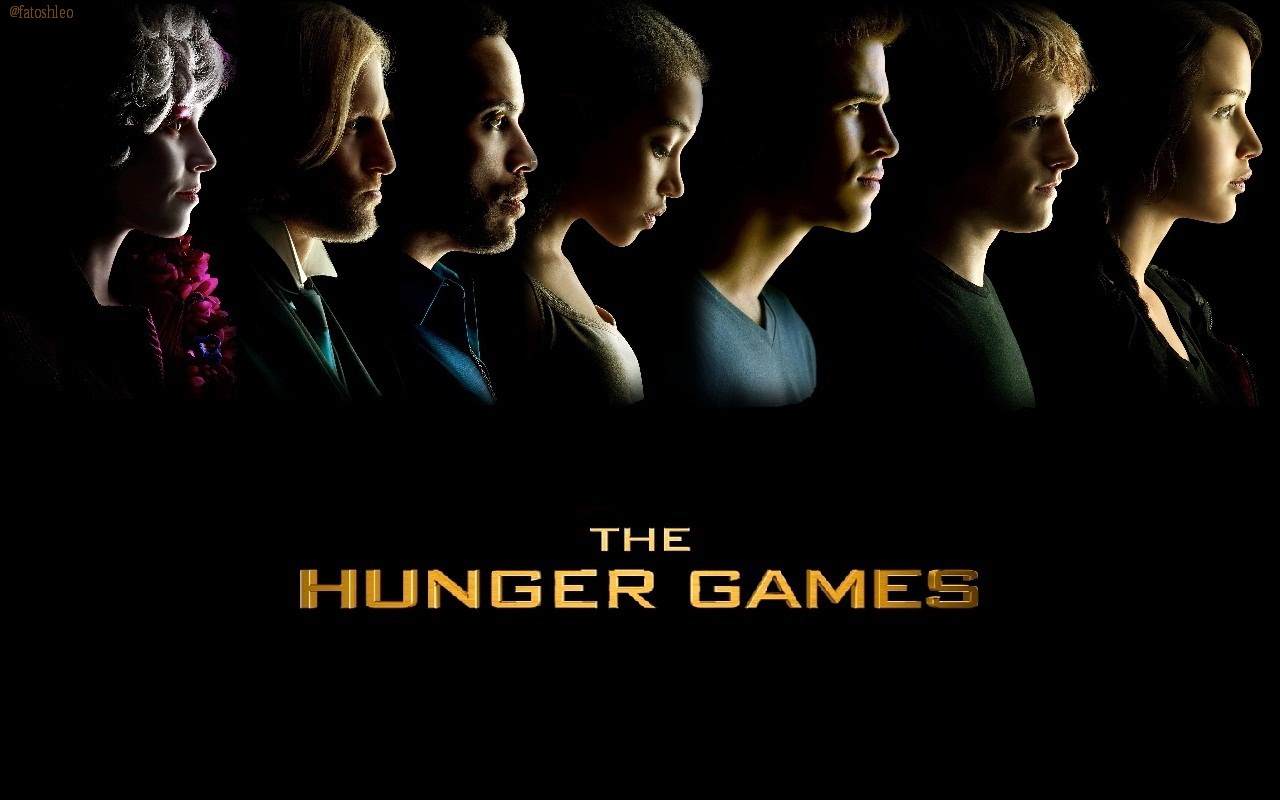
(Review) Gary Ross' "Hunger Games"


You're probably tired of hearing about "The Hunger Games," and I get that. You probably feel it's just another over-hyped book for teens that's all sugar and no substance, which I'd disagree with completely. Or maybe you're one of those people who feel that since the plot is so similar to the Japanese movie "Battle Royale" that you're turned off by the prospect of this story (a story that's completely different and infinitely more political). While I find that idea ridiculous (show me a story that HASN'T been done before in some way) I get the idea of that too.

But I'm not talking about any of those things here.

Hollywood has a way of ruining the good parts of the things we enjoy. There was no need for a second Tron movie (even though I kinda loved it). At other times, Hollywood has a way of bringing out the best of a story, making the movie version an instant classic. Two examples of this, both originally written by Stephen King: "Stand By Me" (adapted from his short story called "The Body") and "The Shawshank Redemption" (based on another short story called "Rita Hayworth and the Shawshank Redemption").

Gary Ross' vision of "The Hunger Games" falls into the former category and felt a little ruined to me, though there were some fantastic aspects to the movie.

The movie is set up almost as if we, the viewers, are actually watching parts of the Hunger Games. Bits of interviews with the Gamemaker and others involved play out like a show being watched in real time. I think if this had been a more pervasive theme throughout the movie, it would've strengthened some of the weak parts that I'll talk about later.


The movie itself doesn't drown in CGI. In fact, so much of it looks real that I had trouble distinguishing the real from the fake most of the time, and this was great. That lack of falseness that CGI emits made the movie feel very much set in the present moment and lent a credibility to the action that was hard to ignore. Where other dystopian/sci-fi movies have a tendency to embrace the shimmery-ness of special effects, "The Hunger Games" seemed to shrug them off for a more realistic approach. This was the right way of thinking, though it may be harder to avoid in the next film (since I know what happens in the second book).


Katniss, the main character, is played almost to perfection by Jennifer Lawrence (see: "Winter's Bone"). She is strong, but not wholly confident in her abilities. The book is set almost completely inside the mind of Katniss, which makes for some interesting adaptations to the screen. Viewers aren't going to want to listen to every one of her thoughts, but it's her thought processes that sweeten the good moments and make the awful moments that much more gut-wrenching.

Throughout the course of the book, Katniss and her fellow tribute Peeta realize that they'll get more outside help from viewers if they play up the idea of a romance between each other. The moral quandary here is that Katniss doesn't feel the same way about Peeta that Peeta feels about her; she's not a liar or a person who uses others as a means to an end, but ultimately she relents and plays up the romance too. Gary Ross glosses over the moments that could have really gotten into this more in-depth, but instead shied away from highlighting them.

This was not only distracting, but it made some of the later scenes (when Katniss is taking care of a wounded Peeta in a cave) fall so emotionally flat. If I had gone into the theater having not read the books, I would've been scratching my head by the end. The romance felt rushed and without much in the way of being anything Katniss truly struggled with. And this is one of the bigger themes of the later books, which makes it incredibly important in getting set up early on.


There is also the issue of Haymitch (played by Woody Harrelson). A notorious drunk and ex-winner of the Hunger Games so long ago, Haymitch stumbles around for most of the book with a hateful attitude and a flask at the ready. This image of him plays out for a bit in the movie, but then quickly turns into Haymitch being some kind of super-likeable guy by the end (which there are *brief* moments of in the book).


Now I realize there's only so much you can do with a two hour movie as compared to a 400 page book, so I'm trying not to be overly-critical. The movie looked fantastic, set wise. The costumes and the design were all great as well. The acting was solid on everyone's parts, but it was (ironically) the writing of the script that seemed to be the most lacking. And this was even with the original author, Suzanne Collins, on hand to help out. I don't know if perhaps having her on set to adjust the script for adaptation was a good thing or a bad thing, but the movie felt like it tried to cram in a lot of really important details (necessary for viewing the next two movies) into a very short amount of time.

Overall, I think the movie is a success. It looks good, it's acted well, and damn near every character looks exactly the way I pictured them while reading the books. The world of Panem is slightly different than I pictured, but I like it, and with Collins at the helm helping, I'm sure it looks the way she wanted it to and that's good enough for me. Now that the main characters are somewhat fleshed out, I'm hoping that the second and third movies delve more into the interpersonal relationships with the characters, as that's the only way a story will ever truly gel together. Character is of the utmost importance. Hollywood can give you all the actors you need, but if there's no onscreen vibe or chemistry between them, all you've got are people acting out dialogue. And that can get very, very boring.


(7,899)

Monday, January 9, 2012

The Revamp of Sherlock Holmes

"Get out. I need to go to my Mind Palace."

When I was a child, my father passed along to me his copy of the full collection of Sherlock Holmes stories. I haven't made it through all of them yet, but it's a book I've held on to for years. The stories themselves have become classics, both for their intrigue and for their intriguing characters.

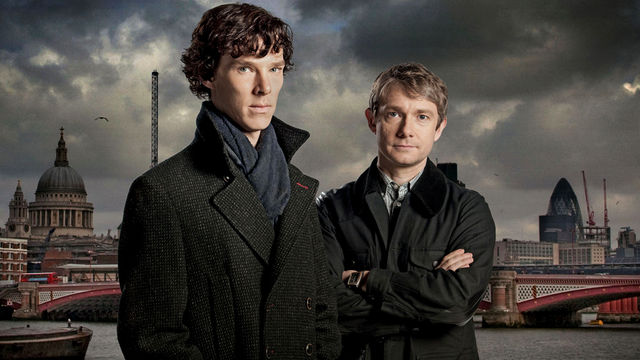
Welcome to the 21st century...where Sherlock has been modified and put up onto the big screen (a'la Guy Ritchie and starring Robert Downey Jr. and Jude Law) but also, more importantly and less well known, to the small screen via the BBC (starring Benedict Cumberbatch and Martin Freeman).


If you're at all familiar with the stories, the picture above needs no explanation; you know exactly whom is whom. Cumberbatch, on the left, plays one of THE BEST Sherlocks I've seen in any adaptation. Freeman, on the right, plays Watson. And to his credit, does a phenomenal job of playing a strong second fiddle.

I caught wind of this series sometime last year and thought "well...maybe it'll be good." It wasn't good...it was absolutely phenomenal. The first episode, "A Study In Pink," is a contemporary play on the original "A Study In Scarlet" and besides giving the viewer a fun detective case, also does a nice job of introducing Holmes to Watson and vice versa. There's a history behind both men that gets explicated (a little more on Dr. Watson's side) so that the viewer comes away knowing more about each persona.

Cumberbatch truly encompasses the brilliant ADD-ism of the Holmes character while keeping himself pleasantly aloof of all the normal emotions found in people of normal intelligence (see: Dr. Watson). He portrays the character perfectly, blending acute perception with just the right amount of ire-inducing wit and commentary. You simultaneously love him while hating him. He is written and acted perfectly.

Freeman has been casted fantastically as well. While not nearly as perceptive as the Holmes character, Watson has always been the great foil; more compassionate, more understanding, more tact. Freeman's Watson is the perfect anti-thesis to Cumberbatch's Sherlock. The two show a dynamic onscreen that Downey Jr. and Law lack (though come close to).

What is most fascinating about this current revamp isn't the the incredibly strong acting, but the fun and inventive ways of showing the viewer what exactly is going on inside Holmes' brain. In the most current episode ("The Hound of Baskerville"), Holmes kicks Watson and another doctor out of a lab so that he can visit his "Memory Palace." What follows are pictures and texts in regards to the clues that he has acquired throughout the previous hour of the show (each episode lasts about an hour and a half without commercials). In the first episode ("A Study In Pink"), we see Sherlock flipping through mentally flipping through weather broadcasts, train schedules, appraising jewelry on the victim and ultimately leaving the viewer to come to their own conclusion about what's going on.

Whether you've read the stories or not, this show is truly one of the best things on television right now. Watch it, download it, get it from a friend, whatever...this is amazing television and I don't say that about much on the boob tube. The writing is solid and does a very serious justice to the original stories. The casting is damn near spot on and the payoff...my god. Two hours of Sherlock Holmes in a contemporary setting?

You'd be daft not to be into it. Just keep the pipe and hat at home...this ain't your daddy's Sherlock Holmes.

(5,130)

Thursday, December 8, 2011

Christmas Stories

Over the years, Christmas has given us crazy shopping sales, an increase in television and print advertising, and a disturbingly higher than average need to trample other shoppers once a store opens up thanks to the stupidity that is Black Friday.


But it's also given us a lot of great stories. Most of them are, personally, overly sentimental, but that's the nature of the season; people tend to be more giving and emotional during the holidays, but not so much during the regular days of the year. So, in honor of the upcoming holiday, here are a few of my favorite must-see/must-read Christmas stories. I grew up watching and reading most of these while others are relatively new to my canon of tradition, especially now that I have young nieces.


Truly one of the funniest movies of all time. That TBS tends to run a 24-hour marathon of it every year only solidifies it more and more as a Christmas staple.Told in a Morgan Freeman-style of narration by a grown-up Ralphie, this story runs the gamut of every ridiculous thing possible about Christmas. From a pack of wild dogs breaking into the house to eat an entire turkey, to a kid shooting his eye out with a bb gun, to the most famous scene of all - that of Ralphie's friend being triple dog dared into sticking his tongue to a frozen flag pole outside the school. If you haven't seen this, you absolutely need to.


Frank Capra made some great movies and this is one of them. I first watched this one with my father many many years ago and it's remained a favorite. Very much a twist on the Dickensian "A Christmas Carol," Jimmy Stewart plays the role of the anti-Scrooge, but who is suicidal due to financial problems. An angel saves him after he jumps off a bridge and shows him the future of his hometown if he had never existed. This has remained a mainstay for many good reasons, but most notably (I think) because it flips the Dickens version on its head and remains interesting.


Tim Burton makes some weird movies, but they're almost always enjoyable (almost). Don't get me started on his remakes of "Alice in Wonderland" or "Charlie and the Chocolate Factory." I visited some friends in LA this summer and got to see the exhibit of Burton's stuff at the LACMA. It was an impressive and daunting collection made up of damn near everything he's drawn or turned into video since the age of 15. The vast majority of the collection was from "The Nightmare Before Christmas," but only because that seems to have been his signature style from an early age.

Jack Skellington, the Pumpkin King, lives in a world where Halloween occurs every day. One day he stumbles across a frozen winter wonderland where Santa exists. Some of Jack's fellow Halloweeners kidnap Santa while Jack comes to understand the nature of this new holiday called Christmas. A weird claymation flick, but a damn good one where Tim Burton's imagination shines.


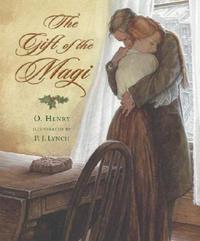
"The Gift of the Magi" was a story that went over my head when I read it at a young age, but the dramatic irony of the piece is gut wrenching. I can't even begin to break it down for you without ruining the beauty of the writing, but suffice it to say that this is probably one of the strongest examples of what the holiday spirit is about. A very quick read by O.Henry, master of the literary twist.


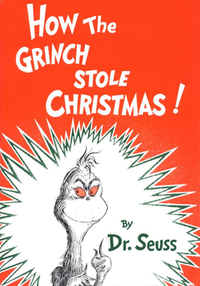
Another TBS favorite during the holiday. I shouldn't even have to analyze this one for most of you. Dr. Seuss was a staple in almost every household of every person I've ever met. The Grinch, during the course of an evening, somehow manages to steal every last bit of Christmas from a town far far below his home. Of course he has a change of heart and comes to understand the meaning of Christmas in the end.


Yeah...you remember this one. Young Billy gets a Mogwai from his father for Christmas. What's a Mogwai? No one but the elderly man at the shop knows, but who cares. They're cute until you feed them after midnight or splash water on them. This one was a decidedly more serious movie compared to "Gremlins 2: The New Batch." I'm still trying to figure out if it was intentionally bad for humor value or they just said "fuck it" halfway through and stopped caring. Either way, the first one is great for the bonding between Billy and Gizmo. The second one is great for all the humor the director gives to the gremlins.


Adapted from E.T.M. Hoffman's story "The Nutcracker and the Mouse King," Tchaikovsky's "Nutcracker Suite" is probably one of the most beautifully put together pieces of music. Set during the holidays, a young girl is visited by a creepy toy making godfather who gives her a Nutcracker soldier. Later that night, she awakes and heads downstairs to check on the Nutcracker, only to find herself in the midst of a surreal battle between other toys her godfather brought (mice) fighting the soldier. From there, the story evolves into a strange and fantastic dream-like journey for the girl and her nutcracker. If you don't like classical music and you can't stand ballet, you're gonna be SOL on this one, but I promise it's worth your time and effort.


There are many, many more that I'm missing here, but we've all got our own tastes...these just happen to be mine. Either way, there's a little something out there for everyone in the way of holiday cheer entertainment.

(4,607)

Friday, November 25, 2011

(Review) Lars Von Trier's "Melancholia"

I watched this movie in the comforts of my friend Surya's living room on Thanksgiving night. We started it at midnight and we were already one bottle of Jack Daniels down and well onto finishing a second of Bushmills. After a day of drinking and feasting, we decided to actually go out to the movies and saw "The Immortals" (made by the creators of "The 300" and, we all agreed, surprisingly well done), so there was really no reason for us to even be awake, much less have the desire to watch a movie we both knew was going to be highly experimental.


Lars Von Trier is known, much like Terrence Malick, for making strange and beautiful movies with an often overbearing amount of darkness to them. This one comes not long after his much talked about "Antichrist," starring Willem Defoe, a movie I am now determined to watch within the next few days after having finished "Melancholia."

The movie is broken up into two parts; "Part 1: Justine" and "Part 2: Claire" and begins with Justine (played by Kirsten Dunst) and her newly wedded husband stuck in the back of a limo trying to make its way up an incredibly windy dirt road. They are two hours late to their own reception and once they arrive, we get to see the intriguing dynamics of all the family members. For one, Von Trier doesn't really give us much background on any of the characters - we're simply along for the ride and if you haven't strapped in yet, you'll fall off during the first loop-de-loop. A certain kind of willing suspension of disbelief is needed as both my friend and I agreed - it felt like the married couple, and many of the guests themselves, were involved in incestuous relationships. This isn't explicitly stated, but there are a few spoken moments that lean towards this being the case. Perhaps this is an unintentional narrative slip, perhaps not. If there is any truth to it, it becomes completely irrelevant to the rest of the story, but we both picked up on an incestuous vibe and we're both very particular about spotting details like that, both in novels and in movies.


There is an unexplained despondency in Justine's character. She can't seem to will herself to be happy despite the fact that it's her wedding day. Her boss, played by Stellan Starsgaard, hounds her throughout the evening in trying to get a tagline for their new ad campaign, even putting his nephew on her as well. Her new husband acts like a man in love; he wants to make love to his wife at the end of the night, he wants her to be happy, and he wants the night to go smoothly. None of this happens and we see him leave his own wedding night when he falls into his own despondency because of her emotional detachment. The wedding was all in order to help Justine come out of her depression, but she can't raise up out of it, which ends up bringing everyone else down despite all the work and time that's gone into the event purely for her benefit.


In "Part 2: Claire," we're firmly in the viewpoint of Justine's sister, who was also her wedding planner. Claire, played by Charlotte Gainesbourg, is married to Kiefer Sutherland's character, an astronomer paying close attention to a planet that appears to be on a collision course with Earth. Kiefer constantly assuages her fears that the planet is not going to collide with them, but will rather come into their orbit and pass by without much fanfare. He even goes so far as to create a crude device for her - a stick attached to a coiled metal circle. When the stick is pressed against her chest and aimed up at the looming planet, she can see the size of the planet within; if the planet appears both inside and outside the metal ring, it's getting closer. If the planet's size is encapsulated completely within the metal ring, the planet is far way and possibly shrinking.

During this post-wedding time, Justine comes to live with Claire and her husband. Her depression has completely overtaken her and the overbearing mood brings everyone down yet again. It is only during the last twenty minutes of the movie, when we approach the climax, that Justine's mood changes into something less despondent and more calm. The blank look in her eyes becomes a kind of willing acceptance of what fate has to offer them all. What she has been depressed about can now be understood with more clarity.


I won't ruin the ending, but I will say this: Surya didn't enjoy the movie as much as I did, but we both agreed that it was fantastically quirky and rendered beautifully. The opening montage of images were, if not confusing, at least gripping. Von Trier has made an incredibly gorgeous movie, but the ending seemed to come too fast and without much in the way of resolution, so it fell a little flat for the both of us. Taking that initial response into account, however, that may have been the point to Von Trier's work. Time is precious. Family is precious. Emotions can be overpowering despite the moments in which we exist, despite the mood we're supposed to have during these times.

(4,293)

Monday, November 14, 2011

The Hunger Games

I had the great pleasure of reading a trilogy of books this year called "The Hunger Games" by Suzanne Collins. Geared more towards young adults, the trilogy consists of "The Hunger Games," "Catching Fire," and "Mockingjay."


I had heard about them and seen them in the bookstore, but it wasn't until my good friend Andrew hyped them up to me that I decided to buy all three at the same time. Andrew's taste is usually pretty spot-on with literature, so I figured if he liked them as much as he was saying, they had to be good.

And I'll be damned if he wasn't right. Each book sits at about 400 pages in length and I read all three in less than as many days. I was so engrossed in the characters and the story that I was half-tempted to call in sick that Monday morning just to finish the third book. I didn't answer the phone, I didn't watch any television, I simply read. There are only a few other sets of books that prompt me to read so voraciously: Stephen King's "Dark Tower" series and, honestly, J.K. Rowling's "Harry Potter" series. While King is geared more towards adults and Rowling more towards much younger readers, Collins' "Hunger Games" sits somewhere in that nice middle area appealing to both.

Set in a strange kind of post-apocalyptic world where the United States is broken up into 12 districts (the 13th is all but completely destroyed), the basic premise is that of a lottery system set up to take two children from each district, put them in a constructed wildlife arena, and broadcast them all fighting to the death until only one remains standing.

While many of the post-apocalyptic tropes are used (overarching government control/domination, separation of classes, and one or more characters "raging against the machine"), these all work. The subject matter is nothing new, not by a long shot, but it's all in the delivery and Collins delivers a truly gripping and engaging story based on two main characters, Peeta and Katniss.

I have lent this trilogy out to friends to read. They in turn gave it to others to read when they were done, and those friends gave it to others when they were done. I just recently got a replacement trilogy back in the mail...which is to say, everyone who's read this has loved the hell out of it. There are certainly some logical gaps in some places and there are places where the writing could be much stronger, but this is overall one of the most compelling sets of books I've read in a very long time, despite being written for younger readers.

Hollywood has recently bought the rights to turn this into a movie and, while I was dubious at first, the full trailer for the movie has been released. After seeing it, I have to say...I'm super excited to see the transition of this one to screen. Of course I'll probably have a few issues after finally seeing it, but based purely on the trailer below, the feel of the movie almost directly corresponds to how I envisioned the books while reading them. You should really go out and buy these books immediately. When you get home, you should read the hell out of them. You won't be disappointed.


(4,089)

Thursday, October 13, 2011

Bravo's "Work of Art"


I have a strange kind of love affair with the Bravo network. On one hand, they produce shows like The Real Housewives of Who Really Cares County and The Millionaire Matchmaker, shows that are so vapid and stupid one must read a book immediately just to replenish brain cells. On the other hand, they produce shows like Top Chef and Work of Art that highlight the fascinating creative process of individuals. I find the latter the most interesting. If more reality television looked like TC and WoA, we'd all be better for it.

I remember watching the first season of WoA and hoping like hell it would get a second season. I don't really care about the personalities of the contestants (though there's something to be said for ego being the cause of one's downfall in almost every situation), but I like that these shows really get behind the thinking and the artistry behind the finished product. We need more thinking, more doing, more brains working in tandem to create and fill the world with new and surprising things.

The first season was a good cross-section of styles: photographers, mixed media, performance artists. Abdi Farah, a super likeable seeming guy, won the season overall. Against even someone from my hometown of Kansas City, I felt he earned the win. Much of what he created was aesthetically engaging but had emotional content as well.


Season Two has started and they've done a good job of casting another cast of talented artists that utilize every medium available. If you'd like to stretch your brain a bit from all the other McTelevision shows out there, give this one a whirl. Getting a behind-the-scenes look at the creative process can often unlock your own creativity in some way, shape, or form. And really...wouldn't you rather watch someone create a piece of art as opposed to watching trashy old women act like drunken sorostitutes anyway?

(2,881)

Saturday, October 8, 2011

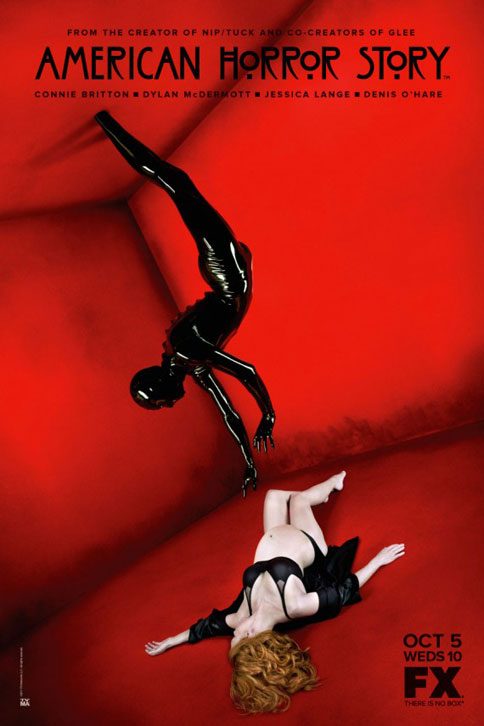
American Horror Story

Like I've said before, I try not to watch too much television, but what I watch, I watch mostly for the writing/storytelling. The acting helps too, but if the story isn't there, the acting ain't gonna make it any better. I've actually been ruminating on trying to write some kind of ghost story, a haunting of sorts, but without all the easy/cliched crap that tends to come with a story of its nature. I'm attempting to come at it from a different angle, so I'm checking out a few different things. Mostly documentaries, but I just watched the pilot of this new show on FX called "American Horror Story."


It's serialized, which is what caught my attention first and foremost since most horror stories are one-offs in the form of movies. And really, if you've seen one horror movie, you've seen about 98% of them. Creepy houses, lingering ghosts with ulterior motives, strange people who appear at random, odd neighbors, and the somehow unsuspecting family that moves into the big, creepy house thinking that it's "perfect." I think once someone figures out how to get rid of every one of these horror movie cliches, we'll all be the better for it.

Unfortunately, "American Horror Story" has each and every one of those cliches. There's nothing unique about the program yet, but it's entirely watchable and completely engrossing. There are your typical flashback scenes of people dying in the house due to strange circumstances, but what really solidified my interest in the program were the questions I was left with, found below. And if my personal questions don't get you interested, this show probably isn't for you.

1.) Does the neighbor actually exist?
2.) Was the wife impregnated by her husband or someone/something else? (my guess is something else)
3.) How do all of the current moving parts/characters relate to the overall story?
4.) Why are all the victims so naive walking into the situation?

Again, while the show is using a lot of the old standbys in telling a ghost story, it's doing a pretty good job. This isn't "Paranormal Activity" stretched out over the course of a viewing season; it's certainly more interesting than that, but the first episode doesn't seem to be showing a willingness to break new ground yet. Though the post-production editing team is doing some really fun stuff with scene-splicing.

(2,708)