Wednesday, January 23, 2013

Artist Profile - Chris Wiley (Kansas City)

Chris Wiley
(Fun fact: this is a self-portrait sketch and not a photo.)


Chris is an artist in the Lee's Summit, Missouri area specializing in the graphite medium. He is a detail-oriented person and enjoys putting as much realism as possible into his pieces. He began creating artwork at an early age, but most recently picked up the pencil again after 20 years of not drawing and began creating artwork again. He believes that if you have the talent, it is just like riding a bike: you never forget. 


 "Forefathers"

Why are you an artist?

From as early of an age as I can recall, I have enjoyed drawing what I see, whether it be with my eyes or my imagination. My grandmother saved all of my rudimentary drawings that I did for her as a child and showed them to me when I was older. I was actually surprised at the attention to detail that I had at such an early age. I still seem to adhere to that philosophy to this day. I enjoy being able to bring lifelike details to all of my artwork. It is that attention to detail that seems to bleed over into everything that I do and is a definite advantage in my real-life career as a pilot. I like to think that I am a "pilot with an artist's soul."


 "Brown Trout"


What is your inspiration?

Inspirations change as our personalities change. My current inspiration is actually my family, my wife in particular.  She is the one that inspired me to pick up the pencil after 20+ years and start drawing again.


 "Harley"


Would you consider yourself a designer or artist or both?

I would consider myself to be an artist for the most part. I draw what I see most of the time.


"Horses"


What is your philosophy of Art?

Art is an expression of the soul. Even if you are doing nothing but simply replicating something that you see onto a canvas or drawing board, some part of your personality is going to come through in that piece of art.


"Little Moments"


What is the role of the artist in our society?

Everywhere that you look, and everything that you see, was created by an artist of some genre, whether it be the plate that you are eating off of, the building that you are sitting in, or the clothes that you are wearing.  Somebody with some type of artistic ability is responsible for that. I think that artists are a staple in our society.


"P-51 Wide"


Where do you see yourself as an artist in 5 years? What are your ultimate goals as an artist?

Optimally, I see myself sitting at home in my underwear doing nothing but drawing and turning out commissions every day. Realistically, I foresee myself continuing to drudge on in my current career, making time for my drawing when I can, much as I am doing now.


"Companion"


What does art mean to you?

To me, art is appreciation of life. Imitation is the best form of flattery.


"Inbound Hot"


You can find more of Chris' work (and purchase prints as well) at the links below:


(25,444)

Artist Profile - Joley Wiley (Kansas City)


Joley Wiley

Joley is a Grumbacher Fine Art Instructor in Lee's Summit, Missouri (a suburb of Kansas City). She currently teaches at the Michael's Arts & Crafts store (14685 West 119th St, Olathe, KS./ (913) 397-0545) and offers several different classes from kids to intermediate level experience in acrylic painting workshops. Thematically, she teaches still life, florals, landscapes/seascapes, portraits, and animal portraits. You can find more information about the details of the classes at the bottom of this post.


Why are you an artist?
It's been a part of me for as long as I can remember.  I tried it, I was good at it, I finally gained the confidence to show my work and people seemed to like it...the rest is history.


What is your inspiration?

That's a tough one.  I'm inspired by things everyday that I never would have considered "inspiring"- peoples' moods, the weather, texture, lighting, nature, photography...my artwork is usually dramatic and bold.  Like my personality, I suppose.


Would you consider yourself a designer or artist or both?

Both. 


What is your philosophy of Art?
There are no rules, no guidelines, no boundaries.  "Art" is a frame of mind.


What is the role of the artist in our society? 
Artists can create an alternative vision for those who can't or won't acknowledge the spirit of creativity.  


Where do you see yourself as an artist in 5 years? 
5 years from now I hope to be doing what I am doing now...sharing my experiences through painting with those who have a desire to learn.


What does art mean to you?
"Art" is someone's soul exposed in a thought-provoking way.  Music, sculpture, painting, drawing...we all have a story to tell and everyone has the ability to do so, regardless of the medium.  Art is a way to express our soul and emotions.


(this link shows lessons, schedules, material lists, student work..etc.)
http://www.facebook.com/JWGRU

Her Classes at Michael's in Olathe:
Every Saturday
Kids Classes (Ages 6-12): 10am-12pm
Beginners (Ages 13+): 12:15-2:15pm
Intermediate (Ages 13+ with instructors recommendation): 2:30pm-6:30pm

Cost:
$25 per student per 2 hour workshop (Kids and Beginners) *plus supplies
$50 per student per 4 hour workshop (Intermediate) *plus supplies


(25,437)

Friday, January 11, 2013

Royal Society Journal Archives

My brain is figuratively exploding at the possibilities of what's in this database right now. It's been up and accessible for a year, but still...that so much information is available for free from some of the world's best minds is truly priceless.

Here's the link: Melty Brain Goodness


"You can read Isaac Newton's first published scientific paper, geological work by a young Charles Darwin, and Benjamin Franklin's celebrated account of his electrical kite experiment. As you trawl through them, you'll find some bizarre experiments from the dawn of peer reviewed publishing - including accounts of "monstrous calves, grisly tales of students being struck by lightning, and early experiments on how to coll drinks 'without the Help of Snow, Ice, Haile, Wind or Niter, and That at Any Time of the Year.'"


 (24,917)

Sunday, January 6, 2013

Books on Deck / Up Next - Pt. X

I'm thankful to have a family that plays into my more nerdy tendencies as I get stoked when books arrive at my doorstep. This year, I think my brother may have "won" Christmas as his gift just showed up. Here are a few of the books he sent that I'll be digging into over the next month or so.


National Book Award finalist Cristina Garcia delivers a powerful and gorgeous novel about the intertwining lives of the denizens of a luxurious hotel in an unnamed Central American capital in the midst of political turmoil. The lives of six men and women converge over the course of one week. There is a Japanese-Mexican-American matadora in town for a bull-fighting competition; an ex-guerrilla now working as a waitress in the hotel coffee shop; a Korean manufacturer with an underage mistress ensconced in the honeymoon suite; an international adoption lawyer of German descent; a colonel who committed atrocities during his country's long civil war; and a Cuban poet who has come with his American wife to adopt a local infant. With each day, their lives become further entangled, resulting in the unexpected - the clash of histories and the pull of revenge and desire. Cristina Garcia's magnificent orchestration of politics, the intimacies of daily life, and the frailty of human nature unfolds in a moving, ambitious, often comic, and unforgettable tale. 


American Gods is Neil Gaiman's best and most ambitious novel yet, a scary, strange, and hallucinogenic road-trip story wrapped around a deep examination of the American spirit. Gaiman tackles everything from the onslaught of the information age to the meaning of death, but he doesn't sacrifice the razor-sharp plotting and narrative style he's been delivering since his Sandman days. 


"Manuel Munoz's vividly suspenseful first novel is a find blend of Hitchcock's chilly elegance and the sordid passions of James M. Cain; a dark, intimate, heartbreaking tale about four very different women, each one longing to escape the confines of her everyday life through the romantic illusions concocted by Hollywood. Their voices will haunt me for some time to come." - Julia Glass, author of The Widower's Tale and Three Junes


"There is no rigorous and effective deconstruction without the faithful memory of philosophies and literatures, without the respectful and competent reading of texts of the past, as well as singular works of our own time. Deconstruction is also a certain thinking about tradition and context. Mark Taylor evokes this with great clarity in the course of a remarkable introduction. He reconstitutes a set of premises without which no deconstruction could have seen the light of day." - Jacques Derrida


"This critical collection combines astute and graceful interpretations of well-known literary texts from the Americas while at the same time displaying a rich global understanding of the broad reach of magical realism. Fashioning subtle rethinkings of the magical realist movement, it will shape discussion of postmodern and postcolonial literary histories." - Jose David Saldivar, University of California, Berkeley


By exploring central issues in the philosophy of literature, illustrated by a wide range of novels, poems, and plays, Philosophy of Literature gets to the heart of why literature matters to us and sheds new light on the nature and interpretation of literary works. 


"I have read several times the long title-essay of Kenneth Burke's latest book, The Philosophy of Literary Form, and still with the sense of an adventure. It is like following the intrepid explorer who is making a path through the jungle. I indicate the range and density of the speculative field, which is poetic theory, and jungle-like; and also the emancipation of Burke's mind, the explorer's, from common academic restraints - especially from the over-all cast of sobriety which he, in a cold tone, calls 'neo-Aristotelian.'" - John Crowe Ransom


(24,661)

Wednesday, January 2, 2013

2012 Reading List

During my final year of grad school, I decided to keep a running tally of the books I had read that year (excluding the ones assigned for class work). In keeping with that tradition, it's been fun to see where my tastes moved along the literary timeline of the previous twelve months and seems to have helped solidify my memory of reading those books, regardless of whether I enjoyed them or not.

My goal this year, since I had absolutely no class work to do after graduating in December, was to read 100 books. I fell way short and only got to the 50-book mark. I'd like to feel sad about that, but I also got 230 pages of a short story collection written from February to December. Win/win.

A few of the books on the list were ones that I started but didn't finish. They're in bold. I'm leaving them on here and will hopefully be finishing them shortly. For the most part, I was pretty happy with this year's choices, but there were a couple huge duds as well.


2012 Reading List:


January

01.) Steven Millhauser - "The Barnum Museum" (237pgs)
02.) Joshua Mohr - "Damascus" (206pgs)
03.) Lemony Snicket - "A Series of Unfortunate Events, Book 10: The Slippery Slope" (337pgs)
04.) Stephen Beachy - "boneyard" (303pgs)
05.) Italo Calvino - "The Watcher" (181pgs)

(1,264pgs total)


February

06.) Stephen King - "Dark Tower, Book 1: The Gunslinger" (224pgs)
07.) Stephen King - "Dark Tower, Book 2: The Drawing of the Three" (400pgs)
08.) Blake Butler - "Scorch Atlas" (150pgs)
09.) Lewis Buzbee - "The Haunting of Charles Dickens" (357pgs)
10.) Stephen King - "Dark Tower, Book 3: The Waste Lands" (422pgs)
11.) Don DeLillo - "Libra" (456pgs)

(2,009pgs total)


March

12.) Stephen King - "Dark Tower, Book 4: Wizard & Glass" (672pgs)
13.) Stephen King - "Dark Tower, Book 5: Wolves of the Calla" (736pgs)
14.) Ben Marcus - "The Flame Alphabet" (304pgs)
15.) Jeremy Robert Johnson - "Extinction Journals" (84pgs)

(1,796pgs total)


April

16.) Amelia Gray - "Threats: A Novel" (278pgs)
17.) Don DeLillo - "The Body Artist" (126pgs)
18.) Don DeLillo - "Love Lies Bleeding: A Play" (97pgs)
19.) Stephen King - "Dark Tower, Book 6: Song of Susannah" (411pgs)
20.) Roberto Bolano - "The Savage Detectives" (648pgs)
21.) Robert Lopez - "Kamby Bolongo Mean River" (177pgs)
22.) Stephen King - "Dark Tower, Book 7: The Dark Tower" (845pgs)

(2,582pgs total)


May

23.) Stephen King - "Dark Tower, Book 4.5: The Wind Through the Keyhole" (307pgs)
24.) Rick Moody - "The Four Fingers of Death" (725pgs)

(1,032pgs total)


June

*none*


July

25.) Thomas Glave - "The Torturer's Wife" (262pgs)
26.) Roald Dahl - "Tales of the Unexpected" (471pgs)
27.) Lemony Snicket - "A Series of Unfortunate Events, Book 11: The Grim Grotto" (323pgs)

(1,056pgs total)


August

*none*


September

28.) Steven Millhauser - "Dangerous Laughter" (244pgs)
29.) (reread) Blake Butler - "Scorch Atlas" (152pgs)
30.) David Mitchell - "Cloud Atlas" (509pgs)
31.) Don DeLillo - "Cosmopolis" (209pgs)
32.) Chuck Palahniuk - "Diary" (260pgs)

(1,374 pgs total)


October

33.) Italo Calvino - "Difficult Loves" (300pgs)
34.) Don DeLillo - "The Angel Esmerelda" (211pgs)
35.) Flannery O'Connor - "Everything That Rises Must Coverge" (320pgs)
36.) Lemony Snicket - "A Series of Unfortunate Events, Book 12: The Penultimate Peril" (353pgs)
37.) Mark Z. Danielewski - "The Fifty Year Sword" (288pgs)

(1,472 pgs total)


November

38.) Lemony Snicket - "A Series of Unfortunate Events, Book 13: The End" (368pgs)
39.) Don DeLillo - "Falling Man" (246pgs)
40.) Chris Adrian - "A Better Angel" (240pgs)
41.) Nick Bantock - "Griffin & Sabine: An Extraordinary Correspondence" (48pgs)
42.) Ransom Riggs - "Miss Peregrine's Home For Peculiar Children" (352pgs)

(1,254 pgs total)


December

43.) Shirley Jackson - "We Have Always Lived in the Castle" (146pgs)
44.) Salvador Plascencia - "The People of Paper" (245pgs)
45.) Gary Lutz - "Stories in the Worst Way" (151pgs)
46.) Dexter Palmer - "The Dream of Perpetual Motion" (353pgs)
47.) Bruno Schulz - "The Street of Crocodiles" (160pgs)
48.) Ryan Boudinot - "Blueprints of the Afterlife" (427pgs)

(1,482 pgs total)

15,321 pages for the year


(24,470)

Thursday, December 20, 2012

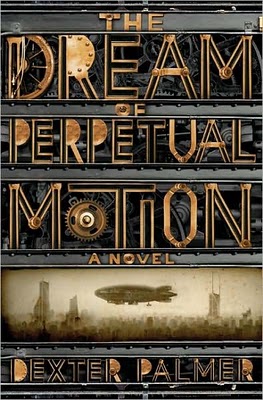
(Review) Dexter Palmer's "The Dream of Perpetual Motion"

Dexter Palmer, 353pgs

Based on the descriptions I'd heard of this one, I came into it with incredibly high hopes - and I was not disappointed. It became immediately clear to me that this novel was the culmination of some of my favorite things: "Alice in Wonderland" meets Terry Gilliam's "Brazil"...but written by a more adult-minded Roald Dahl. And I realize how grand that all sounds, but Palmer's first (first!) novel lives up to the description.

"This is the time of night just before sunrise, the time that no one owns, and if you have found yourself awake and alone during this time, out in the city, outside the safety of the walls you call your own, then you know me, and you have felt what I have felt. This is the hour of the night it's best to sleep through, for if it catches you awake then it will force you to face what is true. This is when you look into the half-dead eyes of those who are either wishing for sleep or shaking off its final remnants and see you see the signs of the twilight in which your own mind is suspended."

While the skeletal parts of this book are typical of the heroic journey (see: Joseph Campbell), this fantastically surreal bit of fractured storytelling keeps things interesting. Many of the main characters of the novel take their names from Shakespeare's "The Tempest": Prospero Taligent, the father and technological Willy Wonka of this world, Miranda, the daughter locked up in her father's 150-floor tower in the middle of the city, and Caliban, the monster of a son put together Frankenstein-like through the pieces of cadavers and kept in a hanging cage locked deep within the 101st floor of the tower.


But it is our protagonist, Harold Winslow, penning this memoir from a zeppelin flying high above the city, that takes center stage. The novel begins with a young Harold Winslow living with his father and sister in an apartment. While out at the boardwalk carnival nearby, Harold is seduced by an exhibit called The Camera Obscura, which is a telescope pointed directly at Miranda's bedroom deck in the Taligent Tower. But like Jack and his beanstalk, Harold gives all his money to the two men running the exhibit in exchange for a whistle which will supposedly get him invited to Taligent Tower to see the reclusive and mysterious Miranda in person.

Prospero Taligent has flooded the world with androids and robots and other mechanical worker beings, trying to achieve what every other inventor has tried to over the years: giving the inanimate a soul, or at least finding the closest approximation, while easing the strains of life on humans. He is beyond rich and his intellect is far greater than anyone else's within the city. And at the moment, he is trying to plan a birthday party for a ten year old Miranda. The men at The Camera Obscura have sold 100 whistles to curious children: 50 boys and 50 girls, each one invited to the party should they actually blow their whistle. That night, Harold blows the whistle.

Harold is whisked off to the party by one of Taligent's robot creations a few days later and finds himself struggling to talk to Miranda at any part of the day. While most of the other children are fighting amongst themselves or being egregiously impolite, Harold continues to be on his best behavior. This lights something up within Prospero, who later pulls Harold out of his regular studies at school in order to give his daughter Miranda a playmate/school mate. All of Harold's lessons are now taken at Taligent Tower.


Things go well for awhile between the two children as they explore the vast and surreal nature of the 150-floor tower. Then they become so close that they kiss, for which Prospero promptly tosses him out and refuses to let him see Miranda ever again.

Fast-forward ten years; Harold works for a greeting card company. His sister Astrid is a nearly world-famous installation artist. His father no longer works and hoards newspapers in their old apartment. The events that unfold from here on out are thought-provoking and more than a little dark. Our anti-hero, Harold, still unable to really make a decision about his life, finds that his every move is being planned out for him. Each action that he makes is one that he was supposed to make; someone is trying to get him to save Miranda from her father's control.

This is the story of an unlikely hero versus a kind of ambiguously dangerous villain. To be sure, having your life controlled by another is a disconcerting feeling at best, but placing this narrative next to the (unfortunately) anemic depiction of Astrid's life shows a stark contrast between the two siblings. And what becomes of Astrid is absolutely jaw-dropping when it happens, which is why I wanted to see more of her in the last part of the book, or at least like her as a character a little more.


But the main thrust of the novel feels like the dissolution of hope through aging. Prospero has performed numerous experiments to keep his daughter young, going so far as to employ a full-time artist to capture the essence of Miranda in physical form for all time. Harold, the anti-hero, is only a little more bold, but not by much. We see the world through his eyes; an aging father with a cluttered home, a sister who still remains bratty and stuck-up, a world that is moving slowly from human-made products and services to machine-made products and services.

But what about Harold's presence on the zeppelin? you may be asking yourself. Well, once Harold (the knight) sets off to save Miranda (the damsel in distress) from Prospero (the villain), the reluctant hero remains reluctant and never truly becomes a hero. The ending of the book is a miniscule let down compared to all that came before it. While this particular story arc is one we've read (and seen) a thousand times before, Palmer's prose swells on the page. His descriptions of some of the inventions and strange landscapes sometimes wanders around and becomes clunky, but his dialogue and exposition in general are spot on.

This was truly a quick and phenomenal read. I probably spent four days getting through it on the train ride into work and back home again. It's an easy one to get sucked into and I hope Palmer releases another book soon.


"Because a subtle shift in the balance of the hormones that saturated your brain was necessary but not sufficient to change you into an adult. It was the noise that the world shoveled into your head that finally made you into a man, wasn't it? Isn't it the sounds out of people's mouths that make us feel we've aged months in minutes? Her tits look great; you hear that for the first time and it ages you. I think you should sit down for this; you hear that and it ages you. The rattle of the tax collector's clearing throat ages you. The curse of the climaxing woman pinned beneath you ages you. The snap of the chicken's neck as it's prepared for the cooking pot ages you. It is not the bending of your bones but the noises of the world that make you grow old, and turn your heart to a block of granite in your chest, and make everyone's head like mine is. Filled with noise and filth."


(23, 912)

Saturday, December 8, 2012

(Review) Salvador Plascencia's "The People of Paper"


Oh metafiction...sometimes you unerringly fail to create something worth reading. Other times, you pop up in books like "The People of Paper" and create a whirlwind of hallucinatory imagery, magical realism-esque elements of the fantastic, and discuss loves lost and won through the battle of man versus the gods. And it is so, so good.

Until I opened this book and looked at the formatting, I couldn't ever remember hearing about it until recently. But I realized that my first workshop professor at USF, Stephen Beachy (author of "boneyard" and who blogs at Living Jelly) presented some excerpts of this book in one of our classes. I remember enjoying what I read, but couldn't really grasp the concept or the formatting at the time. This was well before I began playing with the fracturing of text and format in service of the story.

But I haven't been able to put this book down since it arrived in the mail a few days ago.

On earth, origami surgeons create paper organs for people in need of transplants; a bed-wetting father watches his wife leave him before moving to California with his daughter; that same father gathers support from the local gang and wages war on Saturn, believing him to be the reason his wife left; a whore made completely of paper who leaves scars on the tongues of her lovers; a baby Nostradamus predicts the future and speaks to children in blacked out messages; lovers come and lovers go, all dancing around each other through the haze of war-time.

In the heavens, Saturn's identity is revealed; the book itself, considered "the war," is funded by a rich, older couple; the author writes because of his own lost love while loving another; Saturn's lover is addicted to the sting of bees.

"When in the house of Saturn there are things an EMF member must do, instructions were given to us, drawn up under roofs of lead. Things to be done if one is ever lucky enough to be in proximity of the enemy. The carnation knife must be pulled out of the waistband and then put to the throat of Saturn, dragging the blade across the skin and stubble of his neck, letting his ink drip. Because if that is what he wants, to write, let him write his own blood letter on the cloth and foam of his mattress. A dense, warm prose that stains the floors and always reappears six coats of paint later. Something that will remain longer than any novel will. 

At the very least, if rushed, steal the plot lines and the hundred and five pages that have been written. Leave nothing behind but the title page and table of contents, on which you write, 'You are not so powerful.'"

Plascencia's debut novel (published in 2006), reads like a string of never-ending obituaries. For most of the book, the text is presented in single columns for each character, usually two to a page (but only one column on one page, the left, for Saturn's passages). These are spaced intermittently with longer passages presented in the more standard fashion of formatting with text filling the page in full sentences and paragraphs.


Ultimately, this is a grand soap opera on a massive scale. The movements between the characters on the ground becomes an obvious allegory for the movements between characters in Saturn's world; there is a mirror-imagery that becomes more apparent the deeper one dives into the novel. This in itself becomes a kind of critique of writing (and writers themselves) that I've experienced in the past: how much of ourselves finds itself on the pages of our stories? How do our characters reflect the people of our lives outside of writing?

I worried that this metafictional trope would be used to ill effect by the time I finished the book, but Plascencia does a fantastic job of weaving the two worlds into each other beautifully and with an imagination many would kill to have. Rather than focus on answering the questions of the novel vs. real life, Plascencia digs in and gets into the tiny cracks and rivulets that make up the relationships (no matter how solid or fractured) of the characters introduced throughout these pages. By the time one finishes the book, it's hard to figure if there is a true protagonist or true antagonist relationship between anyone.

While mentioned in small spurts, the use of a whore made of paper who ends up inadvertently leaving cuts on her lovers, becomes the main point of the book: as lovers, we leave scars on those we come in contact with. What those people do with those scars and how they feel about us after is entirely up to them.


Ralph and Elisa Landing
"We came to see the war that we funded. We read the field reports; with our fingers we followed the path of Saturn over maps that illustrated the topography of land and the perilous terrain of love. 
But that was on paper. And if we had learned anything from this story it was to be cautious of paper - to be mindful of its fragile construction and sharp edges, but most mostly to be cautious of what is written on it."

(23,248)

Thursday, December 6, 2012

R.I.P. - Dave Brubeck, Jazz Legend

December 6, 1920 - December 5, 2012


Brubeck Family Statement:
Our much loved and revered father, Dave Brubeck died of cardiac arrest today, December 5, 2012, one day before his 92nd birthday. He died peacefully with family present. The news spread before we even left Norwalk Hospital and our family is deeply appreciative of the phone calls, messages of condolence and continuing tributes in the media and those received personally, certainly a reflection back to us of Dave’s powerful and positive impact on the world. He specialized in long relationships; married to our mother for 70 years, had few changes of personnel in his outstanding quartets or in professional management and many of his fans became personal friends he knew for decades. We thank you all for your appreciation of him and the respect you have shown our family.

Darius, Chris, Dan, Catherine and Matthew Brubeck


(23,133)

Friday, November 30, 2012

Kurt Vonnegut Term Paper Assignment

A dear friend of mine that teaches at a boy's school in Baltimore sent this link to me today. I was never much for Vonnegut's work; not that I didn't appreciate his entries and influence over the entire canon, I just never felt an affinity to his work that others have. Regardless, I had a professor in my undergrad philosophy department that gave us take home mid-terms and finals that read a bit like this, which I always appreciated. The creative effort put forth by the professor tended to, at least personally, bring a bit of joy to an otherwise dreary piece of the semester. It also forced me to be more creative which meant I really had to know the material. There was an onus placed on us students to go above and beyond the normal test-taking mentality and create something worth reading.

David Foster Wallace (a favorite of mine) also had fun with his classes. His syllabi can be found HERE.

I think if more professors were able (or willing, really) to present these kinds of fun/creative educational hurdles to climb, we would find ourselves with a vastly different kind of educated graduate being flung out into the world. I also think it would be to the world's benefit.


and ultimately, from Dan Wakefield's book Kurt Vonnegut: Letters


FORM OF FICTION TERM PAPER ASSIGNMENT
November 30, 1965
Beloved:
This course began as Form and Theory of Fiction, became Form of Fiction, then Form and Texture of Fiction, then Surface Criticism, or How to Talk out of the Corner of Your Mouth Like a Real Tough Pro. It will probably be Animal Husbandry 108 by the time Black February rolls around. As was said to me years ago by a dear, dear friend, “Keep your hat on. We may end up miles from here.”
As for your term papers, I should like them to be both cynical and religious. I want you to adore the Universe, to be easily delighted, but to be prompt as well with impatience with those artists who offend your own deep notions of what the Universe is or should be. “This above all ...”
I invite you to read the fifteen tales in Masters of the Modern Short Story (W. Havighurst, editor, 1955, Harcourt, Brace, $14.95 in paperback). Read them for pleasure and satisfaction, beginning each as though, only seven minutes before, you had swallowed two ounces of very good booze. “Except ye be as little children ...”
Then reproduce on a single sheet of clean, white paper the table of contents of the book, omitting the page numbers, and substituting for each number a grade from A to F. The grades should be childishly selfish and impudent measures of your own joy or lack of it. I don’t care what grades you give. I do insist that you like some stories better than others.
Proceed next to the hallucination that you are a minor but useful editor on a good literary magazine not connected with a university. Take three stories that please you most and three that please you least, six in all, and pretend that they have been offered for publication. Write a report on each to be submitted to a wise, respected, witty and world-weary superior.
Do not do so as an academic critic, nor as a person drunk on art, nor as a barbarian in the literary market place. Do so as a sensitive person who has a few practical hunches about how stories can succeed or fail. Praise or damn as you please, but do so rather flatly, pragmatically, with cunning attention to annoying or gratifying details. Be yourself. Be unique. Be a good editor. The Universe needs more good editors, God knows.
Since there are eighty of you, and since I do not wish to go blind or kill somebody, about twenty pages from each of you should do neatly. Do not bubble. Do not spin your wheels. Use words I know.
poloniøus

And should you be curious about the stories contained in the book discussed, you can find the list below. A couple friends thought this was a cool enough idea to actually do it on our own time, so...looks like I've got a little project to get into during the next few weeks.

John Galsworthy "The Apple-Tree" 39
Saki (H. H. Munro "The Seventh Pullet 104
W. Somerset Maugham "Lord Mountdrago" 112
A. E. Coppard "Arabesque: The Mouse" 141
E. M. Forster "The Celestial Omnibus" 150
James Joyce "A Little Cloud" 170
Virginia Woolf "The New Dress" 187
D. H. Lawrence "The Rocking-Horse Winner" 197
Katherine Mansfield "The Daughters of the Late Colonel" 216
Stella Benson "The Desert Islander" 242
Aldous Huxley "The Claxtons" 266
Edith Wharton "The Debt" 300
Sherwood Anderson "Brother Death" 318
Ring Lardner "Harmony" 338
Conrad Aiken "Mr. Arcularis" 361
Wilbur Daniel Steele "For They Do Not Know What They Do" 385
Katherine Anne Porter "Maria Concepción" 409
William Faulkner "The Bear" 433
Stephen Vincent Benét "Too Early Spring" 453
Ernest Hemingway "My Old Man" 470
John Steinbeck "Flight" 487
William Saroyan "The Pomegranate Trees" 511
Eudora Welty "Old Mr. Marblehall" 526


(22,704)

Monday, November 26, 2012

(Review) Chris Adrian's "A Better Angel"


About two years ago, while doing some drunken book shopping with Surya at City Lights Books in North Beach, I stumbled across Chris Adrian's second novel, "The Children's Hospital," and was completely fascinated with the story. A kind of Noah's ark, but with a hospital and set in modern times. I wish I could say that I've completed the book, but I haven't...yet. It's fat and dense and completely interesting.

But my ever-changing, ever-adapting taste has moved to reading more short story collections at the moment since that's the kind of project I'm working on now. I started writing poetry in my younger days, moved to flash fiction, then right on into full novel-length manuscripts when I realized my poetry was pretty awful. So when I found myself, yet again, doing some drunken book shopping at City Lights, I stumbled across this collection of Adrian's that I'd never heard of before. I pulled it off the shelf, read the back, and immediately bought it.

Adrian is a bit of an odd duck; not only is he a graduate of the Iowa Writer's Workshop, but he is also a doctor now finishing up a pediatric hematology/oncology fellowship at the University of California in San Francisco. This is all to say, the guy is no slouch and his writing shows it. Even when he brings up a lot of medical terminology (which I have zero clue about), it feels natural and essential to the story rather than bogging down the text, which I appreciated immensely. The jargon added to the stories; it never hampered them.

I'm envious of Adrian's imagination; it's far out there and certainly pushes a few boundaries, much in the way I like to think my own writing aspires to do as well. While there was almost an overbearing relation to the events of 9/11 in some of the stories, I didn't seem to mind (even having just read DeLillo's "Falling Man" right before, itself an entire novel based around the events of that day eleven years ago).

Even with his obviously elevated educational pedigree, Adrian comes at the reader in a simple, but fantastic, way. It would be easy for him to slather on the thesaurus-worthy verbage or use entirely too large phrasing to make the same point, but he avoids this and it's to his credit. A 26-page story reads like a fraction of that length and still packs the right amount of punch. These stories ride that fine line between dark and twisted, never really venturing too far off to either side, but stradling each perfectly without the possibility of alienating the uninitiated reader.

What struck me the most about each story was the foil each main character seemed to have with them. In the title story, "A Better Angel," the son of a dying father is followed around by a kind of mythical conscience/guardian angel from an early age. She attempts to keep him on the "right" path, but as he ages and their relationship continues, she reveals that not all people with angels turn into good people. But she is always there, always playing against him and he against her.

"Yet awakening lust wasn't the problem, though eventually the lust that awakened made me a monster and a fiend, and I would waste, and still waste, half my life in thrall to it, screwing whoever would hold still for me in high school and forever beyond, to the exclusion of work and food and sleep, but never of drugs."

"The Sum of Our Parts" was an absolutely beautiful execution of moving from character to character to character and getting into each mindset before flowing into the next through action and dialogue. It's a technique I've always wanted to try myself and Adrian absolutely nails it through the interactions of hospital lab techs and their inner desires for each other. Imagine a room full of sexual tension where no one is attracted to the people they want attracted to them...all while under the supervision of a woman having an out of body experience, waiting to die.

Of all the stories in the collection, however, I think "The Changeling" had to be the most disturbing of them all. A son, a father, and a grandfather living in the same house. After an accident, the youngest son seems to be inhabited by a "chorus of voices" that bite at and snap at the father. What is an obvious story about demonic possession becomes a much deeper tug-and-pull until the final scene where the father proves to the demons inside his son exactly how far and how deep the love for his son actually is. I worried that I'd be turned off by this one, having seen or read about other possession/exorcism style stories, but I was hooked until the end. None of the standard cliched nonsense of floating beds or children puking or screaming at the caregivers, just flat out good storytelling with tension being heightened appropriately along the way.

These are just three of the stories that really stood out for me, but the entire collection is phenomenally solid. Had I not been on vacation when I started (and finished) it, there's a very good chance it would have taken me two days, tops, to finish. Adrian's prose style is fluid and truly moves across the page in a very readable, yet vibrant, way. This will be one I recommend to anyone looking for some new reading by someone they may have never heard of.


(22,493)

Sunday, November 25, 2012

Books On Deck / Up Next - Pt. IX

Like most people, I headed back home for Thanksgiving. I had been on a hunt for a few books out here in the Bay Area and, for whatever reason, couldn't find them. Strangely enough, I found most of them in Kansas City (which isn't necessarily known for its vast literary collections).

So, I came home with a stack of new books and more on the way. I stumbled across a few that seemed interesting along with the ones that I had searched out and here's what is on my reading list for the last part of the year. I'm certainly not going to hit my goal of reading 100 books this year, but I've read some pretty good ones since January and that may be good enough. Quality over quantity, as they say.

I also just finished Chris Adrian's story collection called "A Better Angel," which was one of the best things I've read all year. Look for a review sometime later this week once I've detoxed and decompressed from the holiday.


Taking readers deep into a labyrinth of dark neurosis, We Have Always Lived in the Castle is a deliciously unsettling novel about a perverse, isolated, and possibly murderous family and the struggle that ensues when a cousin arrives at their estate.


Optimus Yarnspinner, a young writer, inherits from his beloved godfather an unpublished short story by an unknown author. His search for the author's identity takes him to Bookholm--the so-called City of Dreaming Books. On entering its streets, our hero feels as if he has opened the door of a gigantic second-hand bookshop. His nostrils are assailed by clouds of book dust, the stimulating scent of ancient leather, and the tang of printer's ink.

Soon, though, Yarnspinner falls into the clutches of the city's evil genius, Pfistomel Smyke, who treacherously maroons him in the labyrinthine catacombs underneath the city, where reading books can be genuinely dangerous...


The Golden Age is a fantastical travelogue in which a modern-day Gulliver writes a book about a civilization he once encountered on a tiny island in the Atlantic. The islanders seem at first to do nothing but sit and observe the world, and indeed draw no distinction between reality and representation, so that a mirror image seems as substantial to them as a person (and vice versa); but the center of their culture is revealed to be “The Book,” a handwritten, collective novel filled with feuding royal families, murderous sorcerers, and narrow escapes. Anyone is free to write in “The Book,” adding their own stories, crossing out others, or even ap- pending “footnotes” in the form of little paper pouches full of extra text—but of course there are pouches within pouches, so that the story is impossible to read “in order,” and soon begins to overwhelm the narrator’s orderly treatise.


* Philip K. Dick Award finalist* Locus Recommended Reading Here are 33 weird, wonderful stories concerning men, women, teleportation, wind-up cats, and brown paper bags. By turns whimsical and unsettling—frequently managing to be both—these short fictions describe family relationships, bad breakups, and travel to outer space.    Vukcevich's loopy, fun-house mirror take on everyday life belongs to the same absurdist school of work as that of George Saunders, David Sedaris, Ken Kalfus, and Victor Pelevin, although there is no one quite like him. Try one of these stories, it won't take you long, but it will turn your head inside out.


The Street of Crocodiles in the Polish city of Drogobych is a street of memories and dreams where recollections of Bruno Schulz's uncommon boyhood and of the eerie side of his merchant family's life are evoked in a startling blend of the real and the fantastic. Most memorable - and most chilling - is the portrait of the author's father, a maddened shopkeeper who imports rare birds' eggs to hatch in his attic, who believes tailors' dummies should be treated like people, and whose obsessive fear of cockroaches causes him to resemble one. Bruno Schulz, a Polish Jew killed by the Nazis in 1942, is considered by many to have been the leading Polish writer between the two world wars.


Imprisoned for life aboard a zeppelin that floats high above a fantastic metropolis, the greeting-card writer Harold Winslow pens his memoirs. His only companions are the disembodied voice of Miranda Taligent, the only woman he has ever loved, and the cryogenically frozen body of her father Prospero, the genius and industrial magnate who drove her insane.

The tale of Harold’s life is also one of an alternate reality, a lucid waking dream in which the well-heeled have mechanical men for servants, where the realms of fairy tales can be built from scratch, where replicas of deserted islands exist within skyscrapers.. As Harold’s childhood infatuation with Miranda changes over twenty years to love and then to obsession, the visionary inventions of her father also change Harold’s entire world, transforming it from a place of music and miracles to one of machines and noise. And as Harold heads toward a last desperate confrontation with Prospero to save Miranda’s life, he finds himself an unwitting participant in the creation of the greatest invention of them all: the perpetual motion machine.


It is the Afterlife. The end of the world is a distant, distorted memory called “the Age of F***ed Up Shit.” A sentient glacier has wiped out most of North America. Medical care is supplied by open-source nanotechnology, and human nervous systems can be hacked.

Abby Fogg is a film archivist with a niggling feeling that her life is not really her own. She may be right. Al Skinner is a former mercenary for the Boeing Army, who’s been dragging his war baggage behind him for nearly a century. Woo-jin Kan is a virtuoso dishwasher with the Hotel and Restaurant Management Olympics medals to prove it. Over them all hovers a mysterious man named Dirk Bickle, who sends all these characters to a full-scale replica of Manhattan under construction in Puget Sound. An ambitious novel that writes large the hopes and anxieties of our time—climate change, social strife, the depersonalization of the digital age — Blueprints of the Afterlife will establish Ryan Boudinot as an exceptional novelist of great daring.

(22,405)